Showing posts with label trekking. Show all posts

Sep 16, 2014

Stand out of Sinop's sunlight


Inceburun lighthouse in Sinop,
the furthest northern point in Turkey.

Sunset view from Sinop's fort.


One of the nicest things about being in Sinop was to remember –yet again- how big and diverse this country is. Located on the Mid-Blacksea coast of Turkey, it is as underrated as Denizli and definitely worth a weekend visit. Interestingly, it is the happiest town in Turkey when in world happiness indexes, Turks are close to the gloomy part of the list, (77th among 156 countries). One of the contributing factors to this happiness may well be that they might know how to live with the least number of things available. Indeed, Diogenes who famously lived in a jar was of Sinop (then Sinope). When asked by the Great Alexander what he could do for him, he famously have said: "stand out of my sunlight". 


All sorts of fish are freshly available
at Sinop.

Fjord like Hamsilos bay in Sinop.

Akliman Bay in Sinop.

Another explanation for the happiness may be the fact that it is in the furthest northern part of the country with the highest amount of sun light. Indeed, a visit to the light house in Inceburun -the furthest northern tip- is a must. It is one of the fewest places in the world where the sun goes up from the sea to also set into the sea. The easiest way to do that is to rent a car or drive to Sinop. When you head out of town towards the direction of the airport, İnceburun, Akliman and Hamsilos are all in the same direction. Hamsilos with its fjord like shape may also serve as the entry point into a hiking trail that is full of endemic birds. Indeed, natural tourism may easily grow in the area given the waterfalls in Erfelek; lake in Ayancik; natural park at Hamsilos and otters under threat of extinction in the area. There are already tour companies that offer it.

Meydankapi mosaics at Sinop archeological museum.


Another view from the mosaics at museum
of archeology in Sinop.
The Fountain of Martyrs at Yalı Kahvesi, Sinop.


The sea, fish and everyhting sea related is in the soul of Sinop. When the fishing prohibition is lifted as of 1 September, fish shops are full, for affordable prices. And restaurants know how to cook it. Fishermen sit around in Meydan Mahallesi and sometimes at Yalı Kahvesi. The latter is a place for everyone to sip tea or coffee and maybe eat a toast. Its humble ways should not fool you as a fountain nearby attests to its historical significance. Indeed, being the shipyard town and port for the Ottoman Navy came at a price for Sinop. When the Ottomans were "the sick man of Europe", the Russians raided the town in 1853 -known as the Battle of Sinop -as part of the Crimean War. Today, the monument for the fallen soldiers is located in the museum of archeology but at Yalı Kahvesi, the re is a fountain commemorating the event. The Fountain of the Martyrs was built with the moneys left in the pockets of the fallen soldiers. Apparently, the Pasha bastions -first built  in the 15th century- were also not much of help given the denseness of the fog. Today, the bastions are decorated with canons and there is constant sound of shelling in the background that makes it all the more real to imagine. 


Monument for the fallen soldiers
 of Sinop Raid of 1853.

Pasha Bastions in Sinop were first built in 15th century.


Street view from few old houses in Sinop.
If you go to Sinop in the summer, the beaches at Akliman, Karaliman and in the city are clean and thus of the few places in Blacksea coast that is so. Another sea related thing in the city is boat modelling which was initiated by two former inmates that were released from the Sinop Prison. Today, there are many shops but Ayhan Kotra seems to have started it. The other shops are all next to his at Iskele Caddesi. Sinop Prison (Cezaevi) is located next to the fortress by the Blacksea and many political and literary figures in Turkey served time here. Given that location, noone has been able to escape it and many movies have been shot in its alleys and corridors. The prison was closed down in 1999 and serves today as a museum. 


A view from the Sinop Prison (museum) today.

The shape of Sinop is like a peninsula but the locals call it an island. If you have a car, driving it all the way will take you to the other side of the city, amid stunning scenery. Along the way, visit Pasha Bastions and drive up to Boztepe where at low visibility, there is a fog horn that warns seafarers. The sea really is the soul of this city. But you can still indulge in meat and Turkish ravioli at Teyze'nin Yeri.


A view from Ayhan Kotra boat modelling shop.

Oct 12, 2013

The Turkish Scotland: Plateaus of the Blacksea

Proudly Turkish in the plateau, Pokut.
Photo: Neslihan Güven

Pokut plateau, at the terasse of Plato'da Mola.

If you are one of those who cannot sit idly on a beach for extended periods of time or have low tolerance for sun, or simply love the nature and hiking, you need to head to the Blacksea region of Turkey. The region is famous for its plateaus, greenery and lately for hiking. In fact, it remains one of the most natural places in the country. In the highlands there are hardly any roads. The plateaus are inaccessible at least 6 months of the year given the constant rain and snow in higher altitudes. In the summer months, it is simply a depot of oxygen.


Plato'da Mola, a chalet at Pokut plateau.

To get there, all you have to do is to fly to Trabzon and take a bus to Ardesen, 20 km. east of Rize. This is also the entry to the Kackarlar Mountain Natural Park. A lot of people drive to Ayder plateau from Ardesen and hike up. We instead were driven through Camlihemsin straight up to the plateau called Pokut, at 2100 metres. We stayed at Plato'da Mola, basically a renovated chalet with five rooms in the middle of the nature. Food is cooked and served inside the 150 years old chalet by the super friendly owners. There is nothing around except the mountains and one is inclined to feel like Heidi and the surroundings in fact feel like the Swiss Alps, if not better. The plateau of Sal is 20 minutes walk away from Pokut and is also an option to stay.

Photo: Neslihan Güven

The road and views to Hazindag from Pokut
with Ares showing the way.

When we wanted to hike, the owners' dog Ares accompanied us to the plateau called Hazindag (the Sad Mountain) two hours away. The 5 km walk was very easy with amazing views. It is possible to continue from here to another plateau called Samistal but spending the night there would be a must. On the way back to Pokut, the fog set in and Ares decided to take us from a longer road (7km). Due to the decreased visiblity, Ares constantly watched us by turning back and making sure we were not lost. The word dog does not do justice to his intellect. 

Photo: Neslihan Güven

Steepy is the byword of the Blacksea region,
at Hazindag plateau.
Photo: Neslihan Güven

The people of the region of Camlihemsin are very proud of their heritage and love the nature. Not surprisingly, they are staunchly against the dam building projects of the government. Their culture is eclectic with Greek, Laz and Armenian tones while their forefathers have gone to Russia for work before the  1917 Revolution. The region seems to have been at the crossroads of many cultures but the names of plateaus remain Armenian: Palovit, Elevit, Tirovit. The last syllabus vit meaning a flat place. Similarly, there are names such as Avusor, Kermukerec, Apevanak or Hacevanak. The plateaus of Ceymakcur or Kotencur give in their last syllabus the Armenian word for water. The owners of the place tell me that they still call cattle for water in Armenian.

Ortan village houses in Blacksea.

The Turkish fondue called muhlama of Blacksea region.

The typical Firtina valley houses of the region,
as viewed from Ortan village.
Photo: Neslihan Güven

The next day we go down to the village of Ortan and stay in another chalet, typical of the region. The road from Ortan to the valley is dotted with street signs bought by somebody from the Roads Authority. Characteristic of the sense of humor of the region, he wrote messages under the signs. No wonder I call the region the Turkish Scotland: rainy and witty:-)

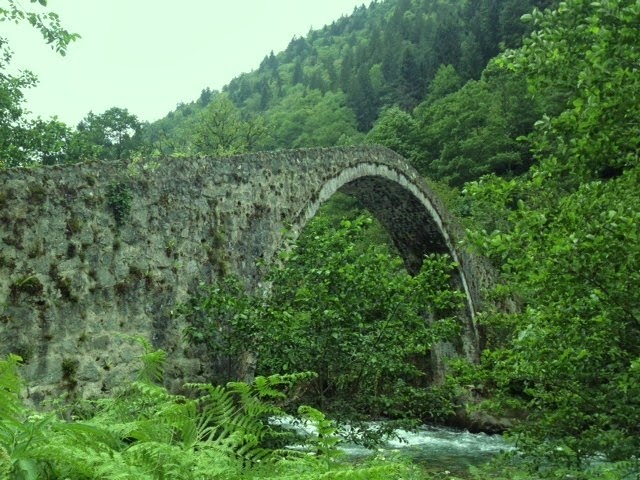
Bridge in Firtina valley.


The Road Authority sign in Ortan says: off you go.