Showing posts with label Art. Show all posts

Jan 30, 2016

Salzburg, do not look so much inward


The rail bridge over Salzach river in Salzburg,
banks of which are perfect for cycling and running.

A view from Salzburg from the castle.

Located on the Western part of Austria, close to Bavaria of Germany, the picturesque Salzburg is surrounded by mountains and two low hills Kapuzinerberg and Monchsberg. It has a charming old town that is a UNESCO site. Although heavily damaged during the Second World War one can see many buildings have been renovated yet still baring dates from middle ages. As a city-state, Salzburg joined the Austro-Hungarian empire, only 200 years ago. It seems to have changed hands and was annexed by Germany during the World War. 


Views from the Mirabell Gardens in Salzburg.

Salz is the German word for salt and it not only gave its name to the city but also to the river running through it, Salzach. Austrians call salt "the white gold" as it, other minerals and water energy seem to have contributed to the wealth of the city and the region for centuries. Fairly easy to get around on foot, one can still take a mini tour which includes the Hellbrunn Palace outside the city. When you cross to the other side of Salzach you can visit the amazing cathedral (Fransizkaner Kirche) and go up to the castle which allows you to see the city as well as the surrounding region. Once up there, you can take a walk to the Modern Museum or reach it via a finucular system. 

The building where Mozart was born is yellow,
the color of Kaiser's, Salzburg.

A view from the Von Karajan's house with his stick
in the hand, Salzburg.

Salzburg was ruled for a long time by arch bishops who happened to be good diplomats avoiding war and thriving on trade and music. The city indeed is the birth place for many musicians, most famous of which are Mozart and the famous conductor Herbert Von KarajanThe birth and later houses of Mozart are clearly marked and the latter is today also a museum. A few hundred metres away from the Karajan house is an interactive sculpture of Marina Abramovic who dedicated her work to Mozart's spirit. At this site, you should sit down on the chair; close your eyes; look inwards and lose track of time, as instructed. And if you wish to enjoy cafe and cake where Mozart and Karajan did, head to Cafe Tomaselli close to the cathedral in the old market. It is the oldest Austrian cafe and it shows! Right acrosss it, is Cafe Fürst the founder of the Mozart Kugeln (famous chocolates). Another good option for café is at the Mozart Museum. The ingredients of these cakes are so excellent, they fill you without being heavy or burning your stomach. Salzburg is also famous for Restaurant Ikarus a Michelin starred restaurant but hard to book. So we had a wonderful meal at Alter Fuchs in the old city. Just enjoy your Schnitzel with Riesling! 

View from Cafe Konditorei Fürst, Salzburg.

The cake lady (Kuchendame) at Café Tomaselli
must be paid separately for the cakes.

Salzburg is a pretty two day get away destination on your way to Hallstatt in the summer or to Zell am See if you are into skiing. Despite all this wealth and music though, there is something dark here or maybe generally in Central Europe. Maybe it is the pessimism emanating from Peter Handke quotes at the Modern Art Museum or it is the weather. Or maybe it is me, having spent eight of my teen years in an Austrian high school damaged my relationship with Austria. Still, at a time when there are sixty million refugees worldwide, an unprecedented number, you have a town so inward looking, its three star hotel reception closes at 6 PM! Austria should wake up to the miserable reality the world is living in and start sharing its wealth with people who risk so much only to start a new life. Indeed, there is so much room in this 200.000 people town. And apparently jobs too, to keep receptions open day and night.                    

Stolpersteine dedicated to the victims of the Holocaust,
after Germany they are also in Austria. 

A view from Zell am See, Austria.
Quotes from Handke on glass doors: "Some couples never get together"
and "only romantics achieve anyhting".

Jul 31, 2011

Art on Prince’s Islands: Escaping the things we do


While we constantly talk about escaping the city, an art exhibition I saw last weekend made me think of breaking the cycle of things I do rather than places I live in. I don’t mean to deny the pleasure of being in a different spot. I just want to stress the importance of doing something different like watching art works in an unlikely holiday spot like the Prince’s Islands.
Sabuncakis mansion on Prince' Islands, Istanbul at the opening.
Photo: Ahmet Sel.

The art works were the outcome of collaboration among three men, artists who also distanced themselves from their familiar surroundings in London, Tel Aviv and Istanbul respectively. Nick Barratt, Nir Segal and Irmak Canevi, went to art school together in London (Slade School of Fine Art) and are good friends. They spent three weeks with each other in a workshop on Prince’s Island seeing “eye to eye” and produced the art works exhibited in the Sabuncakis Mansion on Prince’s Islands - Büyükada from  23 through 28 July 2011. The mansion is also known as the “house with the eye” for it has an eye on it.

Untitled by Nir Segal.
Photo: Ahmet Sel.

Barratt's triangular installation at "eyetoeye",
Polygon blanket, Princes Islands.
Photo: Ahmet Sel.

Irmak Canevi and his friends and fellow artists came up with the idea of the workshop. The Canevis opened their family house on the island to be used as the workshop venue. The caretakers of the house also took care of the three and selflessly fed one delicious meal after another to the lucky artists. Canevi’s dedication to his second career (second life) deserves the generosity of his support from his family and should be an inspiration to those previous slaves of corporate legal culture.

Irmak Canevi's "sponge island" installation at Princes Islands.
Photo: Ahmet Sel.

Typcial horse car from Princes Islands.
Photo: Nir Segal.

What I like most in Canevi’s work is the respect he shows for the sites of his exhibitions.  Previously, when he participated in a group show organized by Galeri Non and Dilara Moran at addresistanbul, he first made drawings of ‘pebble pools’, as he calls them, that punctuate the geometry of the floor plan of this furniture mall. Hence the name of Project, “Pebble Geometry”. Here, Canevi made a sketch of the Greek orphanage at the island which is Europe’s largest monoblock wooden building. Owing to the state of Turkish-Greek relations, the building has remained empty and decaying for decades, when after a European Court of Human Rights decision in 2010, it was finally transferred to the Greek Patriarch. Canevi used charcoal (one of the favorite things to do in the island is barbeque) and traced the texture of the wood pieces he laid under the paper. For pictures of the orphanage refer to here.

Mixed media work mainly based on the map of the island
by N.Barratt&I.Canevi with "Pendulum" in the background
left by Nir Segal.
Photo: Nir Segal

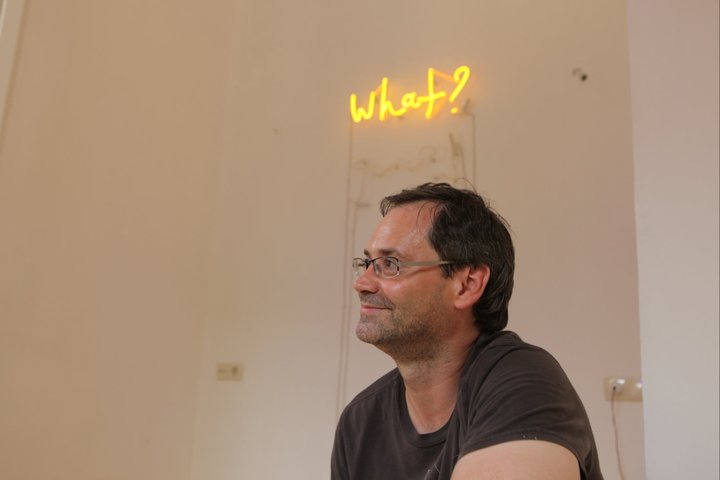
A happy Nick Barratt at the "eyetoeye"
in front of Nir Segal's neon installation "What? Gone".
Photo: Nir Segal.

This alone makes the cooperation between Segal and Canevi more meaningful in the historic low point between Turkish-Israeli relations. The cognizance of location was also apparent in the “island series” of mixed media.…..They were among my favorites as were the neon light “1500m” and “Illuminous”. I also found the installation “sponges” cute with its suggestion of the colors and cacophony Prince’s Islands absorb in the summer. While the “eye to eye” project smells of summer colors and joy of collaboration, it also had multiple trilogies. Three men working for three weeks culminating in Barratt’s triangular installation at the entrance of the exhibition. Looking for a place for the exhibition, they were helped by Mr. Hayri Özen who has been renovating the mansion from a building (converted from a former Masonic connection with its obvious triangles on the roof. Another piece I liked was by Segal’s Run Lola Run.

Three artists getting ready for "eyetoeye".
Photo: Zeren Göktan.

Irmak Canevi and Nir Segal at work to hang a drawing.
Photo: Zeren Göktan.


Given all this, it can be said that “breaking the routine” did everyone good. Mine started with Yalovalı Kardeşler’s kroket (patates köftesi), a must delicacy for everyone visiting the island. It continued with walking amid horse cars racing by my side; dozing in the garden of the Canevi house and ended with dinner at Ali Baba next to the harbor. Milto and Kapri are all good and seasoned choices of restaurants, although Şükrü seemed to be trying too hard to give the island a needless clubby scene reminiscent of the city. I left the island at lunch time next day to beat the returning crowds. Wasn’t the purpose of going to the island to get some peace of mind after all? With the growing popularity of Istanbul as a tourist destination (and Princes Islands getting its share -NYT agrees-) Büyükada seems less and less able to cater to that need. This is exactly when the art scene comes handyJ.


Travelmind, Zeren Göktan (responsible for selection and curation)
 and admirer Despina Minaoglu at "eyetoeye".
Photo: Ahmet Sel.

May 4, 2011

Compassionate architecture: bird houses and sparrow mansions


A view from Ayazma Mosque in Salacak, Istanbul.

Bird mansion in Ayazma Mosque, Istanbul.

Notice the two bird mansions on the side of Ayazma Mosque, Istanbul.

Gates of Ayazma Mosque also features bird houses.
As the important sociologist Nilüfer Göle says (in Mahremin Göçü) Turks’ relationship with modernity has been about forgetting. They have been taught that everything modern and developed comes from the West and being Western means adopting Western ways while forgetting everything that is nice and good about yours to the point of sometimes even being embarrassed about your culture. Politically, Islamists and nationalists were the first to revolt against this concept of “modernization”. While this oversimplification does not justice to the Orientalist tone in it, today, with the growing confidence of the country, many practices, cultures and details forgotten in the past are grabbing renewed attention. One of these is definitely the bird houses and sparrow mansions prevalent in the Ottoman architecture. I discovered them thanks to a tour organized by Fest Travel, one of the best culture tour firms in Turkey. 

A view from Selimiye Mosque in Istanbul.

A bird mansion in Selimiye Mosque, notice the stairs.

Another bird house at Selimiye mosque in Istanbul.
 It is said that the practice of building bird houses on mosques, houses, tombs or other buildings goes back until Seldjuk period. Although it is seen in some parts of Europe and Japan, it is mostly prevalent in the Ottoman geography (including Christian and Jewish places of worship) such as the Balkans and the Middle East. In fact, bird houses are visible in Plovdiv and Veliko Tarnovo in Bulgaria. The practice is said to have religious overtones and is based on Quran’s Surat An-Nur (24:41), saying the following: “Do you not see that Allah is exalted by whomever is within the heavens and the earth and [by] the birds with wings spread [in flight]? Each [of them] has known his [means of] prayer and exalting [Him], and Allah is Knowing of what they do..

Yeni Valide Mosque in Istanbul has varieties of bird houses, simple, bigger.

A master piece at Yeni Valide Mosque, notice the minarettes of the bird mansion.

So if birds are praying and exalting the name of Allah, masters of stonemasonry must build shrines for them. According to Arkitera (a Turkish architectural website) the practice started initially with little holes but then with the influence of the Barock style in Europe, they have also become monumental architectural pieces. While some scholars explain the practice by an emulation of sculptures, some explain it as an architectural dream following Ottoman poetry. However, the practice compeletely disappeared in 19th century.


Eyüp Sultan Mosque in Istanbul and its bird house.

The ceramic tiles at the Eyüp Sultan Mosque in Istanbul.

The gate of Eyüp Sultan Mosque is also decorated with a bird house.

Time for tulips on the tombs at Eyüp Sultan Mosque.
The tour of bird mansions and sparrow houses started on the Asian side of Istanbul in Üsküdar and took us to three mosques that I have never stepped foot. Ayazma Mosque (1760-1) in Salacak, its name implying that it was built on a water sacred for Byzantium; Selimiye Mosque (1801) right behind the grandiose Selimiye Military barracks and the Yeni Valide Mosque (1708-10) in Üsküdar square. The first two were built in Barock style while the latter was more of a classic style. These three had the most extensive and pretty bird houses.
Amcazade Hüseyin Paşa Külliyesi in Istanbul
on Hungarian brothers street.

Beyazıt Mosque in Istanbul has a well designed for birds to drink water.

This well is for birds to drink water at Yeni Valide Mosque in Istanbul.

We then crossed to the European side and arrived at Eyüp Sultan Mosque in Eyüp which right at its entrance greeted us with a bird mansion. Eyüp is a neighborhood which developed after the take over of Istanbul outside the city walls. Today, it is an important religious center. The Eyip Sultan Mosque is not only a mosque but also has a shrine for Eyüp Sultan (Ebu Eyyub El-Ensari). Interestingly, although my grandmother must have spent half of her life in this mosque, I have also never set foot here either. I was not only impressed with the beauty of the mosque, the ceramic tiles of the shrine and the tombs, but also with the crowds (which until then was the main reason for me to refrain from going). Indeed, this mosque is said to be full even in the morning prayer (taking place around 6 AM). For non-Muslims reading this, a Muslim does not have to pray in the mosque but can also pray at home. So the fact that someone goes to mosque for morning prayer at 6 AM, is a serious sign of devotion! When we got there, it was noon on a weekend, so kids with circumcision costumes, married couples and all sorts of people were present at the mosque already. It is definitely a site worth seeing but do not even think of visiting during Ramadan as terrible traffic jams will suck the blood out of you.

Bird house of Laleli Mosque in Istanbul.

General view of Laleli mosque in Istanbul


Do not let the names of all the mosques confuse you. The Asian side mosques are all very close to each other and if you include Eyüp Sultan Mosque, the four places are easily explored within 3-4 hours. It is enough to give you an understanding of the practice. But for the more ambitious bird house lover, the tour continues and becomes an extended Old City tour. Indeed, we then walked on Golden Horn to Architect Sinan’s not so much liked Zal Mahmut Paşa Mosque, built with brick and stone. Here, the tomb of Gevher Sultan also had a bird mansion. 

Close to Grand Bazaar in Mercan district of Istanbul,
a bird house dating from 1764 with a mashallah on it.

Our next stop was Feyzullah Efendi madrasa close to Fatih Mosque in Fatih  (neighborhood named after Mehmet the Conqueror). This madrasa houses an important collection of manuscripts including a copy of the first known Turkish dictionary. A little bit further down is the Amcazade Hüseyin Paşa Külliyesi on Macar Kardeşler Caddesi (Hungarian Brothers street) probably named after Kont (Count) Szechenyi who has established the fire department in Istanbul by an invitation from the Sultan after a big fire in 1871. At those times, Istanbul had many Hungarian immigrants.

In Taksim, Istanbul, every day we pass by without even recognizing
these two bird houses.
Afterwards we went to Ordu Caddesi in Laleli and saw the Barock styled Laleli Mosque. Surprise surprise its bird mansion had birds in it although I felt sorry for them as they were stuck in the middle of traffic and pollution. We then strolled to Beyazıt neighborhood, and saw inside the Beyazıt mosque the well designed for pigeons to drink water. We then descended towards Eminönü and saw civilian examples of bird houses. Totally mesmerized, I discovered that even the good old Spice Bazaar that I went by many times had little bird houses as the well in Taksim right at the entrance of İstiklal Street that I walked by thousand times. So I am glad that my eyes got sensitized for the bird mansions. The question remains how a culture that was so humane, graceful and esthetic in creating these bird houses and mansions has so degenerated it is today only obsessed with building ugly concrete buildings and mosques. Is this all about forgetting?

A shorter version of this post is available at Hurriyet Daily News.

Dec 19, 2010

When a man loves: the story behind the Mihrimah mosques in Istanbul

When the daughter of the Ottoman Sultan Süleyman the Magnificent turned 17, two powerful men wanted to marry her. The name of Süleyman’s daughter was Mihrimah which meant in Persian “the sun and the moon”. One of the two men was a provincial governor while the other was the famous Architect Sinan (originally an Armenian but converted under a system called devshirmehwhose greatest works include the Suleymaniye Mosque in Istanbul. At the time, despite being madly in love with her, Sinan was 50 and already married. So Mihrimah married the governor. Soon thereafter, Sinan was commissioned by the Palace, to build a Mihrimah mosque in Üsküdar (on the Asian side of Istanbul). When finished, the mosque looked like a woman with her hair reaching down below. After a while, still in love, Sinan started building this time on his own (without being commissioned) on the European side of Istanbul on a high hill a small mosque, also named Mihrimah.
Mihrimah mosque interior, facing Mecca.
The dome of Mihrimah mosque in Istanbul.

Pray time for believers in Mihrimah mosque in Istanbul.
Play time for kids at the Mihrimah mosque in Istanbul.


When finished, this mosque equally looked like a woman whose hair reached her ankles. There was another particularity: on 21 March, the birthday of Mihrimah (happens to be also when the day and night are equal), one can see that when the sun is setting behind the minarette of the Mihrimah mosque on the European side, the moon is coming out behind the Mihrimah mosque on the Asian side. The sun and the moon: Mihrimah… what a love, what a man devoting his art and mastery of skill to his unacquainted love…. (Special thanks for the story).


Sketches of the Mihrimah Mosque in Istanbul.


Renovators are still at work in Mihrimah mosque (in Edirnekapı), 
on European side of Istanbul.

Mihrimah mosque from outside, in an unassuming part 
of Istanbul called Edirnekapı.
If you are now curious about the Mihrimah mosque on the European side, I have good news for you. It is located in Edirnekapı which is very close to St. Choir Church. So, first visit St. Choir because it is clearly marked in the neighborhood. You can be amazed by its exceptional Byzantine mosaics and frescoes of 14th century. Then go to Mihrimah mosque which is newly opened while reconstruction work is still going on in the garden and courtyard. Inside, the mosque has been gracefully renovated. Me and my friend sat down for a while and admired the stained glasses while watching a few that were praying. For all their faults, no one can blame the current government for owning the Ottoman architecture in the city by renovating all those thus far decrepit wells and mosques.


Jesus Pantokrator fresco of 14th century at St. Choir Church (museum) in Istanbul.
Photo: Zeren Göktan.

The fresco of the death of Virgin Mary at St. Choir in Istanbul.
Photo: Zeren Göktan.


Giftshop of St. Choir featuring pretty travel journals.
Photo: Zeren Göktan.
Lastly, have a meal in Asitane, next to St. Choir. This is a restaurant famous for Ottoman Palace cuisine, for more information about which can be found here. There is a lot of work behind this restaurant since they have studied hard to revive the forgotten cuisine  that due to the guild tradition kept all recipes secret. For instance, I ate “stuffed quince” which was cooked with a recipe from 1539. I must say they knew what they were doing back then. It was a killer!

The stuffed quince of 1539 at Asitane restaurant in Istanbul.
Photo: Zeren Göktan.
Then head to Istanbul Modern for more art: but this time for modern Turkish painting. The location of the museum is right by the entrance of the Golden Horn. So you should plan to have your sunset drink at the Café of Istanbul Modern. Especially the terrace of the café has a view all the way from the Bosphorus Bridge to Blue Mosque and beyond. The busy ferries, the sea and seagulls make a typical Istanbul picture that cries out to be taken by the tourist who follows TravelmindJ. Also note that the museum store has wonderful gifts for those back home.

A view of the Bosphorus at the terrace of Istanbul Modern's café.


Old Peninsula: from left to right Topkapı Palace, St. Sophia and the Blue Mosque
from the terrace of Istanbul Modern.


Inside Istanbul Modern's café, you can also 
have the same view by looking at the mirrors.
Lastly, if you happen to be in Istanbul until mid January 2011, at Istanbul Modern you should visit the exhibition about Armenian Architects of Istanbul. While Turkey tries to come to grips with its past, it is pretty amazing to realize that beyond the rhetoric, we owe the silhouette and many landmark buildings of Istanbul to Armenian architects. One family, the Balyans, seem to have especially contributed the most by building the Dolmabahce Palace; Kuleli Military School (where Muammer Kaddafi was a student);  Selimiye military barracks (world’s largest historical military barracks); Çırağan Palace, Ortaköy Mosque (my favorite); Beylerbeyi Palace; Akaretler and today’s Istanbul University’s Presidency. The latter used to be the Ministry of War in the last years of the Ottoman Empire when the government was basically ruled by three Pashas of the Ottoman Army. Sadly, in 1915, in this building they decided to exile the whole Armenian population of Turkey to Syria which basically led to the massacre and ultimate death of millions of people and a culture to vanish.

A photo from the Armenian architects exhibition showing the
Presidency building of Istanbul University.
Yes, my Istanbul is a bizarre place that gives you amazement, pride, hope and sadness, all in one day. This is why I love it.


A shorter version of this post is available at hurriyet daily news.