Showing posts with label mountain. Show all posts

Mar 8, 2015

In defense of Switzerland

Room with a view in Arosa, Switzerland.

Sunny side of Grindelwald, Switzerland.


No visit to Switzerland is complete without
a cheese intoxication  aka fondue.

Switzerland gets so much blame for its banking secrecy and complacency in money laundering (according to die Zeit, lately through its art scene, health tourism and boarding schools, see here), its other beauties do not get enough credit. If one of those is the chocolate and the Swiss watches, another one is definitely the Alpine mountains and the various ski resorts scattered in and around them. Whether its Gstaad, Samedan, Arosa or Grindelwald, the scenery is picturesque, the runways are well kept and marked with signs of wind and avalanche warnings and the valleys are connected to each other through all sorts of gondolos, ski lifts and chair lifts. In fact, the skiing facilities and the mountain resorts are so well designed and thought about, they constitute an industry. At the same time, for all the talk about tourism killing the mountains, there is barely any building that violates the natural setting of a mountain town. Despite the not so easily affordable prices, it is a destination to go for peace of mind and good service.

Everything in the Swiss mountains is geared to
accommodating life with snow, Arosa, Switzerland.

Hotel Bernina at Samedan, Engadine region, Switzerland.

Laderach in Grindelwald offers irresistable goodies after skiing.

Notice the helmet holding hooks at the luncheon hut
in Berner Oberland.
Ski lift at Ischgl mountain, Berner Oberland, Switzerland.

In fact, your average Swiss has an amazing know how of mountain conditions whether it is the direction of the wind or the altitude or risks of avalanche. By the way they are skiing, you may even think that they are not only cool but even passionate, until ofcourse you realize that most of them are like other staid and reserved Euros (sorry). Nevertheless, one has to respect the nature and the Swiss do. The rules in skiing is a little bit like sailing, never play games with the sea (remember Schumacher and do not go off piste), always observe, exercise caution and double check. In case, you are not into skiing or the weather is too cloudy for skiing, there are also other options at the Swiss alps. You can go to a spa; marvel the architecture and the Helvetian culture of the Engadine region or even visit the Nietzche Museum in Sils; indulge in shopping in the stores of Gstaad. In other words, as always, the Swiss always have something to offer that they can then turn into money. Grüezi!


Samedan in the Engadine region has very pretty old houses
that kept its unqiue architecture.


Samedan in the Engadine region has beautiful architecture.


Apr 20, 2014

Aphrodisias an underrated if not better Ephesus

The road to Aphrodisias, Aydin, Turkey in spring time.


Sebasteion, Aphrodisias, Aydin, Turkey.


When it comes to visiting an ancient site in Turkey, it's Ephesus up, Ephesus down... one cannot but help but wonder why being named after the goddess Aphrodite, Aphrodisias is so underrated despite being as preserved as Ephesus, if not better. In addition, given its inland location between Aydin and Denizli, one can still beat the crowds in Aphrodisias which is impossible with Ephesus. Plus, it has an amazing museum. Established on a grid plan, Aphrodisias truly is an amazing site to visit. As we entered, I was immediately struck by the Sebasteion, the building symbolizing unity of the Ruler and God. The Greeks apparently figured out 2500 years ago what was awaiting Turkey in the 21st century under Tayyip Erdogan.


View from the Acropol towards the theater
in Aphrodisias, Aydin, Turkey.

Under Romans, Aphrodisias became the capital of Karia but it was also a pilgrimage center as well as a cultural center as evident by its 10000 people capacity theater and 30000 capacity stadion. The stadion is one of the best preserved of its kind in the whole country and makes you wonder what it must have been like to watch a gladiator fight. 


The stadion at Aphrodisias is well preserved despite
countless earthquakes.
At the time we visited, the nature was mingling with Aphrodisias in all sorts of ways: flowers found their way through the thousand year old stones; pools that carried water to the city and baths that resisted earthquakes were filled with rain water and frogs. One could still see the snow capped mountains in the distance that helped fill those pools. What was most striking behind the Hadrian baths was the remnants of a (possible) school of sculpture. Even today around Babadag mountain, there are marble stone factories. What a continuity!

Tetrapylon, Aphrodisias, Aydin, Turkey.


As one slowly passes through the Tetrapylon to exit Aphrodisias, one should take a break at the museum cafe. After that visit the museum and see the 1958-61 taken black-white pictures (by famous Ara Güler) of Aphrodisias with the dirt poor villagers of the time using the stones in various ways. Then visit the killer museum. Amazingly preserved sculptures of the ancient city are on display here. 

The three graces Joy, Splendour & Bloom at the
Aphrodisias Museum, Aydin, Turkey.


Nero & Agrippina at Aphrodisias Museum.

The next day, head to famous Pamukkale, 20 km away from Denizli. Its literal translation to English is cotton castle and indeed, the huge mountain is like a castle and the white stone is like cotton. Use all the sunblock you can since white is pretty good to burn your skin down. As you enter and walk up bare foot, one is struck by the nature's work. Again, it's a pity that this famous tourist spot in Turkey is so crowded even in April. 


One of the many travertine pools in Pamukkale,
Denizli, Turkey.
Once you are on top of Pamukkale, head to the Thermal Pool. Taste a gözleme with cheese and spinach and then head to the theater of Hierapolis where you will get an amazing view of the region with its vineyards. In fact, Pamukkale is a local wine brand and you should taste it. Its advertisement is now forbidden thanks to the 2013 introduced alcohol restrictions. But do not be fooled, Mr. Erdogan's government is not trying to impose its conservative life style in a country with 80% of its population not drinking. They are just concerned about their citizens' health even when the country does not have a drinking problem. Then look around. It's kind of sad that all this Greek civilization is now struck within the borders of this increasingly authoritarian country. Wait a minute, what is the semantics for authoritarian (autokrator)? Isn't it coming from Greek? 


Thermal pool at Hierapolis, Turkey.


Theater at Hierapolis amid the valleys of Pamukkale.

Oct 12, 2013

The Turkish Scotland: Plateaus of the Blacksea

Proudly Turkish in the plateau, Pokut.
Photo: Neslihan Güven

Pokut plateau, at the terasse of Plato'da Mola.

If you are one of those who cannot sit idly on a beach for extended periods of time or have low tolerance for sun, or simply love the nature and hiking, you need to head to the Blacksea region of Turkey. The region is famous for its plateaus, greenery and lately for hiking. In fact, it remains one of the most natural places in the country. In the highlands there are hardly any roads. The plateaus are inaccessible at least 6 months of the year given the constant rain and snow in higher altitudes. In the summer months, it is simply a depot of oxygen.


Plato'da Mola, a chalet at Pokut plateau.

To get there, all you have to do is to fly to Trabzon and take a bus to Ardesen, 20 km. east of Rize. This is also the entry to the Kackarlar Mountain Natural Park. A lot of people drive to Ayder plateau from Ardesen and hike up. We instead were driven through Camlihemsin straight up to the plateau called Pokut, at 2100 metres. We stayed at Plato'da Mola, basically a renovated chalet with five rooms in the middle of the nature. Food is cooked and served inside the 150 years old chalet by the super friendly owners. There is nothing around except the mountains and one is inclined to feel like Heidi and the surroundings in fact feel like the Swiss Alps, if not better. The plateau of Sal is 20 minutes walk away from Pokut and is also an option to stay.

Photo: Neslihan Güven

The road and views to Hazindag from Pokut
with Ares showing the way.

When we wanted to hike, the owners' dog Ares accompanied us to the plateau called Hazindag (the Sad Mountain) two hours away. The 5 km walk was very easy with amazing views. It is possible to continue from here to another plateau called Samistal but spending the night there would be a must. On the way back to Pokut, the fog set in and Ares decided to take us from a longer road (7km). Due to the decreased visiblity, Ares constantly watched us by turning back and making sure we were not lost. The word dog does not do justice to his intellect. 

Photo: Neslihan Güven

Steepy is the byword of the Blacksea region,
at Hazindag plateau.
Photo: Neslihan Güven

The people of the region of Camlihemsin are very proud of their heritage and love the nature. Not surprisingly, they are staunchly against the dam building projects of the government. Their culture is eclectic with Greek, Laz and Armenian tones while their forefathers have gone to Russia for work before the  1917 Revolution. The region seems to have been at the crossroads of many cultures but the names of plateaus remain Armenian: Palovit, Elevit, Tirovit. The last syllabus vit meaning a flat place. Similarly, there are names such as Avusor, Kermukerec, Apevanak or Hacevanak. The plateaus of Ceymakcur or Kotencur give in their last syllabus the Armenian word for water. The owners of the place tell me that they still call cattle for water in Armenian.

Ortan village houses in Blacksea.

The Turkish fondue called muhlama of Blacksea region.

The typical Firtina valley houses of the region,
as viewed from Ortan village.
Photo: Neslihan Güven

The next day we go down to the village of Ortan and stay in another chalet, typical of the region. The road from Ortan to the valley is dotted with street signs bought by somebody from the Roads Authority. Characteristic of the sense of humor of the region, he wrote messages under the signs. No wonder I call the region the Turkish Scotland: rainy and witty:-)

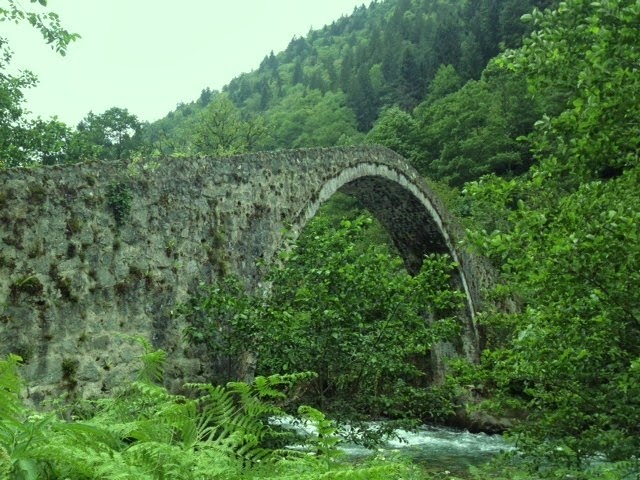
Bridge in Firtina valley.


The Road Authority sign in Ortan says: off you go.