Showing posts with label Aegean. Show all posts

Aug 30, 2015

Holidaying with the refugees in the Dodecanese

In the summer of 2015, Greece made it to headlines either for financial ruin or for refugees crisis. In the Dodecanese islands off the Turkish coast, you see less of the first and plenty of the second. After all, the Syrian war is not ending despite four years of devastating warfare and it is now the middle classes' turn to leave the country. As entering Europe is allowed only illegally, they therefore land in the closest Dodecanese Islands like Lesvos, Chios, Kos, Leros off the Turkish coast. Usually they loom at the harbour either waiting for ferries to take them to mainland Greece and beyond or at police stations on the side of the road while lining up for registration.

Hora on the top of Patmos island, Greece.

Travelmind is a family enterprise: my sister is posing in Hora.

Hora has many nice shops overlooking Patmos island.
One of the furthest islands off the Turkish coast, Patmos did not change much since I saw it ten years ago. Given the distance, it is not receiving refugees but many pilgrims that arrive by huge cruise lines on a daily basis. Indeed, Patmos' Hora is called the Jerusalem of the Aegean. It has been declared a UNESCO site as well as a "holy island" by the Greek Parliament for its religious significance. If you want a little peace and quiet in Hora, you should pick a day where a cruise won't be coming. After a tour at the top with excellent views, have dinner at Jimmy's with the best view of Skala and beyond. If it is a cruise day, just skip dinner in Hora and head down to Skala. Dinner either at Pandelis or Tsipouradikos by the sea are excellent options.


View from Jimmy's in Hora, Patmos.
A view of Skala from Jimmy's Balcony in Hora at Patmos island.


The best sunset in Patmos is on the road to Kampos.
At Tsipouradikos, the tables are set by the sea.
Patmos is a small island and transportation is easy with taxis but renting a car is also an option. We stayed to the north of Skala in Kampos. Although the Kampos beach can be crowded, it does not have that many buildings as other popular hotel areas like Grikos or Skala. Its village square up the road is very nice. Across the church, Aroma is a nice place to enjoy island food like goat and lamb, deliciously cooked. Other beautiful beaches include Agrio Livadi; Livadi Kalgiron (a must if you like the atmosphere of a fishermen's refuge); Lampi (another must) and Livadi Gerano.

At Kampos beach, enjoy Taverna Agnadi.

A farmer in Kampos, Patmos island.

Kampos beach, Patmos island.

Lampi beach on Patmos island.
While Patmos is relatively far from Turkey, Leros is much closer. It is also much bigger than Patmos and there is a lot to see. As we got off the ferry in Lakki, the refugees were hiding from the sun in the shadow of empty buildings and a park. It is indeed a sorry feeling to pass them by and head to your hotel. We stayed in Aya Marina at La Maison des Couleurs, a beautiful mansion with few rooms. When staying there, swimming in Panteli beach is an option but it can get crowded in its narrow strip. If you walk down to Aya Marina, dinner options at Taverna Bratsera or Mylos are highly recommended. In fact, the whole Aya Marina Bay is quite nice with cafes. Walking by the refugees filling the patio of the police station there in full evening do is an embaressment, at the same time, it is an opportunity to see their situation and face the consequences and delusions of European political decision making. An example is a restaurant owner's accussatory tone who said that they were coming to Leros from "us" ignoring the fact that "we" already had two millions of them in Turkey.

Vromolithos beach in Leros island.

Breakfast table at La Maison des Couleurs at Leros.
View from Mylos Restaurant towards Aya Marina, Leros island.

The famous wind mill at Mylos, Leros island.

In our short stay, we loved the Vromolithos beach. It was like Bodrum in the 1980s which gave us a sad feeling. In fact, walking by the beautiful summer houses in Leros, most of which are either for sale or empty and crumbling, one also sees opportunity in the economic crisis: it is possible to run away from the calamities across the border to here, not only for the refugees but also for us. Unlike them, I would rather stay, rent a place in a totally serene world, with pristine waters and an unspoilt coast. In fact, we are so lucky to have Greece to have in our immediate reach. All you have to do is to go to Bodrum and take the ferry.

The Lime Bar at Merikia, perfect spot to end the day.

The French playing petanque in Merikia Leros
right in front of the War Museum.

Italian architecture in Lakki, Leros island.
As with many of the Dodecanese Islands, Leros has an interesting history. Italy's occupation of the Islands left its mark not only in terms of Italian identity cards (see picture) but there is Italian architecture to be seen around especially in Lakki. In Merikia, close to Lakki, there is an interesting  museum from the Second World War that we could only see from the outside due to being open only half a day. Ironically for the European venture though, the French were playing petanque in its very vicinity.

Apr 20, 2014

Aphrodisias an underrated if not better Ephesus

The road to Aphrodisias, Aydin, Turkey in spring time.


Sebasteion, Aphrodisias, Aydin, Turkey.


When it comes to visiting an ancient site in Turkey, it's Ephesus up, Ephesus down... one cannot but help but wonder why being named after the goddess Aphrodite, Aphrodisias is so underrated despite being as preserved as Ephesus, if not better. In addition, given its inland location between Aydin and Denizli, one can still beat the crowds in Aphrodisias which is impossible with Ephesus. Plus, it has an amazing museum. Established on a grid plan, Aphrodisias truly is an amazing site to visit. As we entered, I was immediately struck by the Sebasteion, the building symbolizing unity of the Ruler and God. The Greeks apparently figured out 2500 years ago what was awaiting Turkey in the 21st century under Tayyip Erdogan.


View from the Acropol towards the theater
in Aphrodisias, Aydin, Turkey.

Under Romans, Aphrodisias became the capital of Karia but it was also a pilgrimage center as well as a cultural center as evident by its 10000 people capacity theater and 30000 capacity stadion. The stadion is one of the best preserved of its kind in the whole country and makes you wonder what it must have been like to watch a gladiator fight. 


The stadion at Aphrodisias is well preserved despite
countless earthquakes.
At the time we visited, the nature was mingling with Aphrodisias in all sorts of ways: flowers found their way through the thousand year old stones; pools that carried water to the city and baths that resisted earthquakes were filled with rain water and frogs. One could still see the snow capped mountains in the distance that helped fill those pools. What was most striking behind the Hadrian baths was the remnants of a (possible) school of sculpture. Even today around Babadag mountain, there are marble stone factories. What a continuity!

Tetrapylon, Aphrodisias, Aydin, Turkey.


As one slowly passes through the Tetrapylon to exit Aphrodisias, one should take a break at the museum cafe. After that visit the museum and see the 1958-61 taken black-white pictures (by famous Ara Güler) of Aphrodisias with the dirt poor villagers of the time using the stones in various ways. Then visit the killer museum. Amazingly preserved sculptures of the ancient city are on display here. 

The three graces Joy, Splendour & Bloom at the
Aphrodisias Museum, Aydin, Turkey.


Nero & Agrippina at Aphrodisias Museum.

The next day, head to famous Pamukkale, 20 km away from Denizli. Its literal translation to English is cotton castle and indeed, the huge mountain is like a castle and the white stone is like cotton. Use all the sunblock you can since white is pretty good to burn your skin down. As you enter and walk up bare foot, one is struck by the nature's work. Again, it's a pity that this famous tourist spot in Turkey is so crowded even in April. 


One of the many travertine pools in Pamukkale,
Denizli, Turkey.
Once you are on top of Pamukkale, head to the Thermal Pool. Taste a gözleme with cheese and spinach and then head to the theater of Hierapolis where you will get an amazing view of the region with its vineyards. In fact, Pamukkale is a local wine brand and you should taste it. Its advertisement is now forbidden thanks to the 2013 introduced alcohol restrictions. But do not be fooled, Mr. Erdogan's government is not trying to impose its conservative life style in a country with 80% of its population not drinking. They are just concerned about their citizens' health even when the country does not have a drinking problem. Then look around. It's kind of sad that all this Greek civilization is now struck within the borders of this increasingly authoritarian country. Wait a minute, what is the semantics for authoritarian (autokrator)? Isn't it coming from Greek? 


Thermal pool at Hierapolis, Turkey.


Theater at Hierapolis amid the valleys of Pamukkale.

Aug 9, 2013

No summer house crowds, just serenity in Datça-Hisarönü

The half moon and the star in Old Datça, Turkey.


A typical Old Datça house, Turkey.


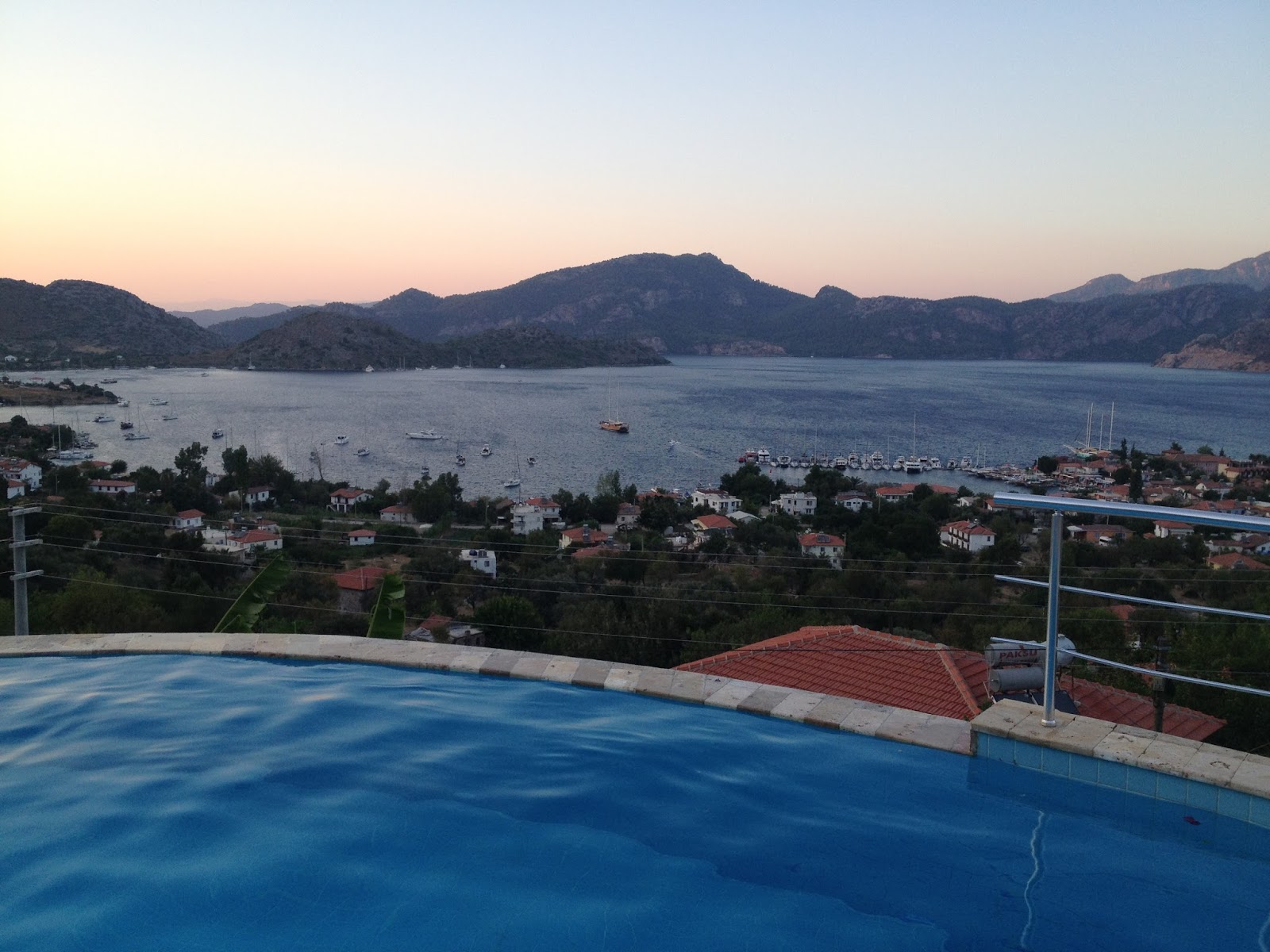
If you are tired of the crowds in Bodrum, the place to go on the Turkish coast these days is Datça peninsula. Datça used to be famous for its deadly curvy and narrow road which has only been recently expanded. Although it can be reached by boat from Bodrum in one hour and a half hours, the beauty of the peninsula is maintained by the fact that it is three hours away from Dalaman airport. This is also why even yacthing is less developed here than Bodrum or Marmaris. Notwithstanding its relentless wind, olive and almond trees, what is less known about Datça and especially the summer house resort Aktur is that it is home to a high number of retired generals of the Turkish army! Not surprisingly, the peninsula is a staunchly secular part of Turkey. 


Palamutbükü in the southern part of Datça peninsula.

Gabaklar bay in the southern part of Datça peninsula.

Yachts anchored in Hayıtbükü, southern part of
Datça peninsula, Turkey.


Old Datça is the place to stay if you want peace and quiet in old stone houses left by Greeks. It lies just outside the new Datca and was made famous when the poet Can Yücel adopted it. Although accommodation there is more pricey, it is worth the peace and quiet. Renting a car is the key to explore the pristine beauty and protected bays of the Datça peninsula. Datça is also a place where the Greek island Symi, one of the Twelve Islands, close to Turkey constantly rears its head. Tune your radio to listen in! If you want to enjoy the good local mezes of Datça head to downtown Fevzi although it can be a little bit pricey.


Ovabükü, at the southern part of Datça peninsula.


Sunset at Knidos, Datça peninsula. 


One day you should drive out to Palamutbükü. Building is forbidden here so there is only one hotel  (Mavi Beyaz) and all others are bungalow or make shift type. The beach is really the main reason to go out there. Pick any of the beach restaurants that serve good food. We choose Tuna which also has bungalows. Another option is to go to Gabaklar where the beach facility is more sophisticated where beds under built in shadows await customers. On the way back from Gabaklar, spend some time in Hayıtbükü and sit at the cafe on the corner just to hang out. Lastly, one day could be spent at Ovabükü at Hoppala also in the same direction with a visit to Knidos at sunset. It is a popular stop with the yachting crowd and will take your breath away. One last stop should be the Kargı Bay in Datça where cold water flows into the sea and makes swimming an excellently refreshing experience. If it is full moon, Kargı is also very good place to watch it. Take a dive and swim in the moonlight!


Knidos at sunset at the tip of Datça peninsula.

Yachts seeking refuge at Knidos, Datça peninsula.

And Travelmind enjoys Kargı bay in Datça town
while overlooking Symi island, Greece.

You may now be ready to leave the Datça peninsula and head towards Hisarönü bay. This is the eastern part of Datça peninsula before reaching Marmaris. Travelmind first headed out to Bozburun which has been gaining visibility among the yachting crowd in recent years but its real beauty is that many popular places to stay can only be reached by boat. Therefore, hotels offer bed-breakfast and dinner which makes it easier for guests. One of these is the outrageously expensive Sabrina's Haus and the other one is Bozburun Yacht Club with its boutique hotel where you can rub shoulders with the young and beautiful of the acting crowd in Turkey. The latter is also known for its good food which Travelmind tasted. Alternatively, spend an afternoon here even if you stay somewhere else and taste their margarithas and caipirinhas before the club boat drops you off at your hotel's pier. 


In the bay of Bozburun on our way to the yacht club, Turkey.

A view from Bozburun yacht club, Turkey.


Travelmind explored bays further away from Bozburun as well such as Söğüt or Serçe. Both are popular with the yachting crowd although the latter is less known and developed. Lastly, Selimiye can be visited which seems to be the more lively and more green than Bozburun and Söğüt. It has nice houses, beaches, hotels and restaurants that dot its coastline and make a nice board walk at night. After spending almost two weeks visiting all these places, my conclusion is better bad roads to keep off the summer house crowds.


Selimiye bay, Turkey.


Sep 16, 2011

At Cunda family pansions of 80s turn into boutique hotels


Typical Cunda house in Ayvalık.


Views from Arthur Restaurant in Cunda overlooking the bay.


Sobe Hotel, on the cover of Travel&Leisure in August 2011, recently opened in Cunda island just off Ayvalık. The hotel's combination of old (stone) and new architecture (glass) in common areas as well as bathroom (marble and glass) gives it a sophisticated touch while cute details such as a tray of welcome lemonade served in room gives it a homey feeling. I was also enchanted by the quality of hospitality items such as soap and gel in bathrooms. It is those things that really make the difference for me. It is also why I consider it a perfect spot for a weekend get away. (I must caution that I did not take the hotel's shuttle to the beach so you must find out about that otherwise).


Views from Sobe Hotel, Cunda island, mixing old and new.


Cunda is full of typical Aegean charm and Greek houses. The loneliness of the Taxiarchis church adds to the air of calm in the island while the restaurants on the seaside provide the vividness. Luckily, Cunda is not much known by foreign tourists. Therefore, the mezes and fish in its great restaurants are reasonably priced although the same cannot be said for accommodation. We ate at Arthur and all the mezes including its kroket (potato balls) was yummy! When in Cunda, taste the mastic ice cream sold at the local stores.


Typical streets of Cunda island, Turkey.

The Taxiarchis church on Cunda island is falling apart.


I would say Cunda’s greatest advantage is its closeness to the Greek island of Lesvos in case you want to hop off across the sea. Another is its magnificent olive oil. After the population exchange between Turkey and Greece, Turks from Crete island were settled here so they continued the local tradition of olive oil production. Indeed, the best olive oil in Turkey is produced in the Edremit Bay area nearby and Ayvalik is one of the places that you find it. Just jump into any store that sells it along with soap. You cannot go wrong.


When I was a kid, my parents would make a detour just to spend one night at Cunda. They loved the island but back then I could not understand why. It was a downtrodden place. We would spend the night in a family pansion. While the owner lived in the ground floor, we as a family would share a room in the upper floor. And the worst part for a kid, the toilet was in the corridor. It is now a cute memory as all those houses are renovated and converted into boutique hotels.

In the typical laid back Aegean fashion,
these local men said they considered it
a privilege to live in Cunda island.