 |
| Fishermen along Sava river, Belgrade. |
 |
| El Toro, in Hala Beton, Belgrade. |
Having lived in Kosovo for one year right after the NATO bombing campaign, the number one rule when travelling/living in the Balkans is this: Do not discuss politics with anybody. The rule applies stronger if you are from one of the previous occupiers-like myself- unless you want a lengthy history lesson in detail. My hard learned lesson notwithstanding, I could observe that Kosovars' "love to hate the Serbs" attitude immediately softened when the topic was switched to Serbia's capital. Ever since, I thought that if it was an object of admiration even for Kosovars, Belgrade must be really nice. Fulfilling my wish after more than ten years later, I must say it went way above my expectations.
 |
| Kalemegdan Park, Belgrade. |
 |
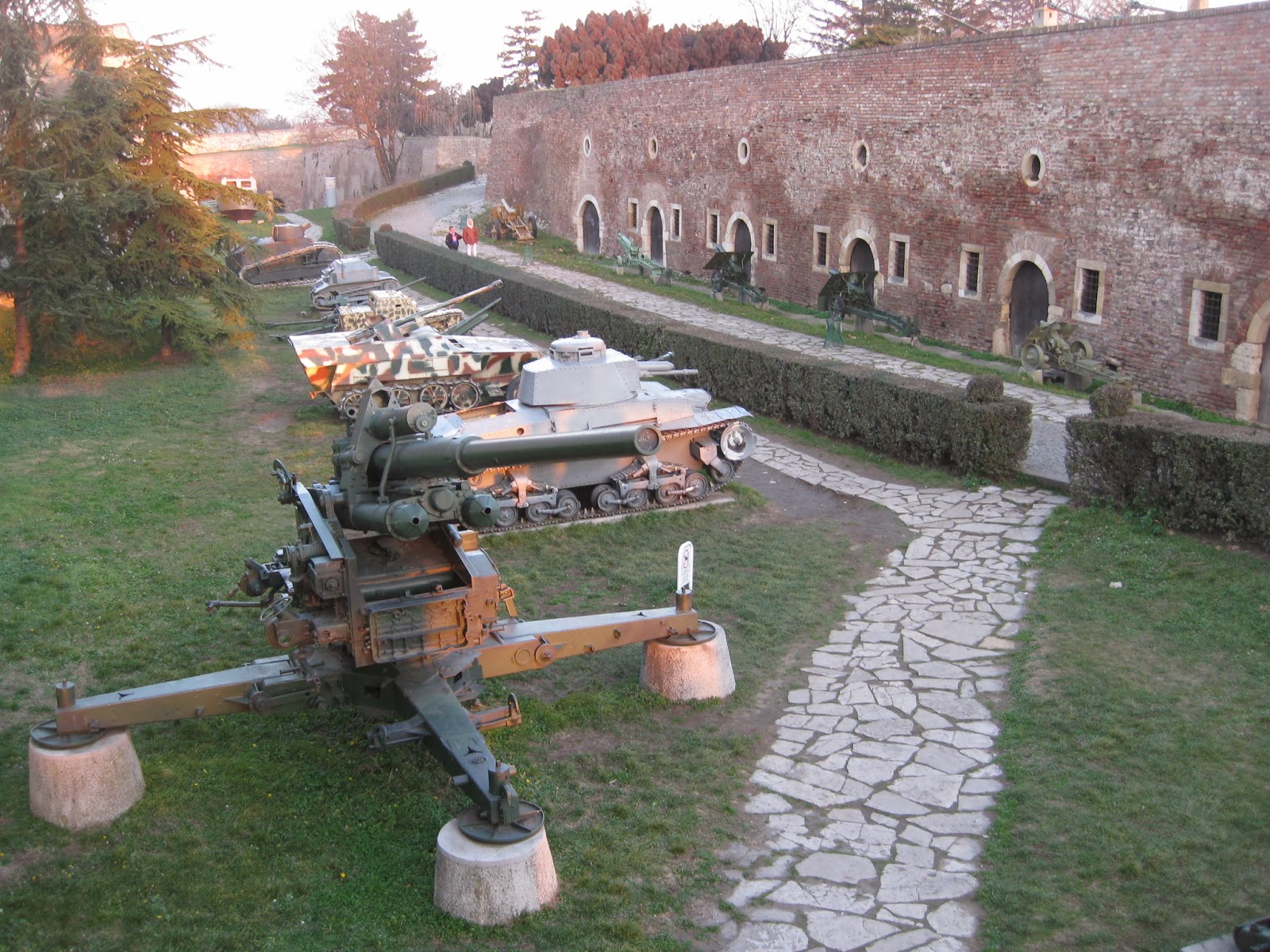
Inside the castle weapons from Second World War
are displayed, Kalemegdan, Belgrade. |
Belgrade is absolutely grandiose with wide streets and beautiful buildings that bare witness to its past glory as part of Austria-Hungary and as capital of ex-Yugoslavia. Its location between two rivers and life alongside those rivers on floating restaurants, hotels, bars and cafes makes the city very charming. For sure, there is a certain sadness in the poverty ridden faces of its elderly. As they buy walnuts and peppers in the open market, their broken expressions make amazing portraits while reminding one what bad politics can do to a country. Indeed, the Balkans have not only seen physical damage of war, but also exodus of its peoples with whole communities uprooted from places they lived for centuries. Seen as the culprit of wars, Serbia has been cast aside by the international community for a long time. As it seems to be finally emerging from political isolation, Belgrade's city dwellers, who have been bombed for four times in hundred years seem upbeat, helpful and friendly unlike other Central-Balkan neighbors in Prague, Zagreb and Budapest. It looks like an accident of history that Serbia ended up in such obscurity despite being the largest and most populous country of ex-Yugoslavia and despite its very central location in Souheastern Europe with about ten neighbors.
 |
| Inner Istanbul Gate, Belgrade. |
 |
| Views from Kneza Mihaila. |
Belgrade is worth a lenghty visit of at least three days, where possible four and even five. Kalemegdan (Square of the Castle in Turkish) and the park surrounding it are the central tourist attractions in the Old City (Stari Grad). What is really nice about Kalemegdan is that lots of local people enjoy it too. It's a perfect place to watch them while the sun sets over the two rivers and the new Belgrade and locals enjoy a tour or two of chess, a true Slavic obsession. To our suprise, the park also contained the tomb of the Ottoman general and grand vizier Ali Pasha who died in battle in Serbia in 18th century. The park has also towers, walls and other monuments.
 |
| Nikola Tesla Museum, Belgrade. |
If you go down the park, you can enjoy a lazy afternoon in one of Hala Beton's nice cafes (we picked Toro) right by the banks of the Sava river with the rich and the cool of Belgrade. Or you can exit the park towards the city. It will lead you direct to Kneza Mihaila, which is the main pedestrian shopping center of the city. Grand buildings, street art performers and cafes abound here. The street then ties into the Kralia Milana and when you turn left, you end up in the Republican Square and further up in beautifully cobbled Skadarska Street (Bohemian Quarter) with plenty of restaurants. If you want to wander around art galleries or enjoy concerts, Kneza Mihaila and the Kolarac building and the Akademski Square are also good options. Off Kneza Mihaila street on Kralja Milana one can also see the impressive Yugoslav Drama Theater building which at the time of our visit was showing Harold Pinter plays. Arts will get bigger in Belgrade, for sure.
 |
"The past goes on forever" barely visible,
Stari Savski bridge, Belgrade. |
If you sit by the river and enjoy a drink of cafe in Hala Beton, you will be struck by the number of people who run, cycle and fish along the Sava river. No wonder we spent all our lives watching Serbian basketball, tennis, waterpolo, volleyball and handball players! For a list of Serbian sportspeople, click
here. Not to deny their hard work, I believe they owe this success also to the athletic Slavic posture. With men close to 1.90 and women 1.80 meters, when it comes to height, one can easily suffer from inferiority complex in Serbia.
 |
| Skadarska street, Bohemian quarter, Belgrade. |
 |
| St. Sava Cathedral, Belgrade. |
Walking over the Brankov bridge towards Zemun would allow you to take beautiful pictures of the city overlooking the Stari Grad. Once you cross the river, the banks of Danube are dotted with boats and yachts and even hostels. One can only imagine them in the summer when they are full of people, partying. We ate at Gabbiano at the yacht club and went for desert and Slivo to Hotel Moskva. Always full and having hosted famous people of the past, it is the place for people watching.
 |
| Hotel Moskva, Belgrade. |
 |
| Hotel Moskva, Belgrade. |
.JPG) |
| On the banks of Danube, Belgrade. |
.JPG) |
| Staring at Zemun, Belgrade. |
At night, passing by the super stylish new Gazela bridge, venture out to Ada Ciganlija (Ciganlija island). This is where you will find live Gypsy music with locals singing and dancing. Be aware that the Crna Pantera (Black Panthers) is an impossible place to find in the island with almost no sign and a shady and dark entrance. Once you are there, the place makes you feel like you entered a time capsule with musicians all dressed in black playing some familiar tunes you thought were Turkish. The stage is complete when a guy who sells red roses enters the scene. As Belgrade is famous for its nightlife, we went to Teatro and then to the Stefan Brown that is located on the ninth floor of an apartment building with people dancing on the top of the bars. Other recommendations from a local friend included Brankow Club and Disco Bar Mladost but check with the local scene as these places seem to come and go.
.JPG) |
| View from Savski most bridge, Belgrade. |
.JPG) |
View to Gazela bridge
from Ada Ciganlija, Belgrade. |
 |
| Ministry of Interior, bombed during the NATO campaign. |
 |
| Ministry of Foreign Affairs, Belgrade. |
We stayed at Hotel Excelsior at Kneza Milosa, right by the Serbian parliament where crowds chanted for Milosevic to go. It was close enough to Stari Grad but also very central in other ways, allowing one to see and observe many things in the city. One of these was the St. Sava Cathedral which looks like a mosque to my Muslim eyes. Nikola Tesla Museum dedicated after the work of the inventor of many modern technologies we use in daily life, was also close. Tesla's life is almost a foreplay to what was expecting his country a century later. Born in today's Croatia, he seems to have lived the life of a Austro-Hungarian until he immigrated to the United States. Despite the income that flew from the patents of his inventions, his extravagant lifestyle as a scientist seems to have led to poverty. Years after his death in a hotel in New York, the government arranged for his return to the then capital of ex Yugoslavia. His ashes are now on display in this museum in Belgrade because he happened to be a Serb, although he sat his foot there for only one day in his life.
 |
| Serbian Parliament by night, Belgrade. |
On the way to the airport, the taxi driver asked me whether I have seen other parts of ex Yugoslavia. Carefully avoiding the subject of Kosovo, I talked about my visits to Skopje, Prishtina, Montenegro, Bosnia and Croatia. I even said Belgrade was even prettier than Zagreb. I talked about the beauty of Croatia's Dalmatian coast and Osijek. I thought by not mentioning Vukovar I was playing safe, forgetting that part of Croatia was shelled by Serbs during the war. Sure enough, the driver said he was there twenty years ago. As this seems to be during or immediately after the war, a silence fell between us. I didn't ask him what he was doing there and he didn't volunteer any further explanation. Indeed, when one meets people who are 40 and older, one cannot help but wonder what these people were doing during the Balkan wars. A legitimate thought when I saw with my own eyes a 2014 calendar with Radovan Karadzic's picture on it. As reconciliation remains a distant dream in the Balkans, will Belgrade with its night life, resonable prices, sadness but livelyness turn the corner despite corruption and sleaze in the country? Only time will tell. Until then, Belgrade will be the new
Beirut.




.JPG)
.JPG)
.JPG)
.JPG)


