Questions you get from foreigners about your country very much depends on your country’s foreign policy or the media portrayal of it. Thus, as my American colleague and myself were waiting for our luggage at the airport in Lahore, we kept staring at hundreds of bottled liquid that came out instead of our luggage. As a Muslim, to me it was a totally ordinary sight that pilgrims brought home zamzam water from Holy Lands but my American friend asked the crucial question: “is this gasoline?”. Notice that this conversation took place about a month ago, before Bin Laden was raided in Pakistan. Even though we both knew that no airline in the world would admit hundreds of bottles of gasoline on board, the anecdote is still telling of the image of the country.
 |
| Entry ceramics at the Lahore Fort, Pakistan. |
 |
| The entry gate to Lahore Forte. |
 |
| Close view of the entry to Lahore Forte. |
 |
| Inside the Lahore Forte. |
This is not to say that there are no security problems in the country. For instance, we were told that our names were not going to be written on the signboards of the hotel, we were to go to the sign of the hotel. There were road blocks on many places until we got to the hotel at which time the security at the hotel checked whether we had explosives with a device that cost USD 50000. Indeed, our host did not leave us alone any moment. We have been told that the Pakistani security establishment is a bit murky and it is not hard to agree given the latest events involving Bin Laden. There are excellent analysis od the situation, one here; and another here.
 |
| Ceilings of the Lahore Forte. |
 |
| A view from the Lahore Forte to mystical shrines nearby. |
Nevertheless, people passed by us in their colorful clothes, old taxis in various paintings and the traffic flew just like in any other big city. I did not feel any threat or similar. I even started to play with my phone and realized that there was free WIFI connection on the street, while our host pointed out to the headquarters of the Kashmiri terrorist group, bringing me back to reality.
 |
| And a little Pakistani angel visiting the Lahore Forte. |
Lahore is said to be more stable and prosperous than other cities in Pakistan. It attracts migrants who are said to work in brick factories polluting the outskirts of the city where bonded as well as child labor is supposed to be common. Located in the state of Punjab which was cut in half by the partition in 1947, I found the city green and colorful. Punjab is home to 90 million people in the country. A Punjabi daily speaks Urdu, Pashtu, Punjabi and English and unlike my country, language is not even an issue. Punjab means Persian for five waters meaning the five rivers passing through it. (Backgammon players from Turkey will recognize the word “penj” for five and “ab” as water in the old language). Here is a list of more common words we have: ziyafat; müşkül; şahin; hidayet; meşkale; ikbal; ticaret; rıza; ikrar.
 |
| An afternoon at the Lahore Forte. |
 |
| Royal Mosque in Lahore. |
 |
| And yes, they wanted a picture of me too in Lahore. |
There are so many languages spoken in Pakistan, one wonders how you keep a country like this together? 160 million of them. As you wonder around the vibrant city, it is obvious that unlike the way put in the media, Pakistan is not a failed state. Obviously, it has huge problems but it also has a deep culture and history. Most of it all, it has an incredible human capital that has studied in the best schools of the world. All day, I was surrounded with amazingly good English speakers who were very well educated.
 |
| Outside the Lahore Forte. |
 |
| No wonder that Pakistan is a large market for motorcycles. |
At dinner, I was talking to someone who has worked at the World Bank for a long time and recently met our Head of State when he visited Pakistan. We discussed my favorite writer Orhan Pamuk, his books Snow, Istanbul and Museum of Innocence. No doubt owing to Pamuk’s talent, literature connected us as we shared a dilemma so well described by Pamuk: western educated elites living in eastern societies sometimes as a foreigner in their own country. How we wake up one day and realize that our countries will never be like what we dream of and sadly adopt our lives to this reality until we mature to view that it is not all that bad to be like western societies. We also discuss how long gone the days when after the US, Europe was such fresh air.
 |
| Filipino jeepney's Pakistani version in Lahore. |
 |
| A wall in Lahore. |
Many ailments of Pakistan such as the military involvement in politics sounds terribly familiar as I read through the local newspaper that refers to Joel Migdal’s “Weak state strong society” thesis. Trying to understand the country, I flip through the many articles in recent issues of the Economist. If you want to read books that came out on Pakistan recently, here are some recommendations I read in the local newspaper. One of the writers, MJ Akbar, apparently makes an interesting argument that the Pakistani is stronger than the idea of Pakistan while the idea of India is stronger than the Indian. All this interest me even more. And the Economist recommends this book.
 |
| Crazy about the electric grids in Lahore. |
As for sightseeing, we make first to the Lahore fort. It is huge, run down but also beautiful. It is also full of people some of which are very interested in having pictures with me while kids shake my hands. As a pale white person, I totally attract attentionJ. The view of mosques from the fort’s platform is quiet mystical with the Taj Mahal like architecture. It is also possible to view Minar-i Pakistan which was erected to commemorate the signing of Pakistan resolution which paved the way for the founding of Pakistan.
 |
| Jinnah watching the Wagah border. |
 |
| Ta ta, here is the border Wagah, notice the crowd on the Indian side. |
As we walk out of the fort, on our left is the royal mosque and on the right the brothel of Lahore (Heera Mandi). Our hosts joke that it was a perfect situation for the Moghul emperor. In between, there is the shrine of Allama Iqbal, the national poet of Pakistan. He lived in Lahore before Pakistan came into existence and the airport in Lahore is named after him. We ran into celebrations of his 80th death anniversary. On our way back to the hotel, we pass from roads where men with henna on their beard or hair take an afternoon sleep, play cards or just sit idly. We see colonial brick buildings, pass by a place called Charing Cross as well as Qaddafi StadiumJ. Our host tells us funny jokes about India and Pakistan. Two dogs meet at the Pakistani-India while they are crossing the border. The one from India is very thin. So when the Pakistani dog asks him why he is coming to Pakistan, he answers: there is no meat in India, I am starving. Why do you want to go to India? The Pakistani dog says: I can eat meat but cannot bark in PakistanJ.
 |
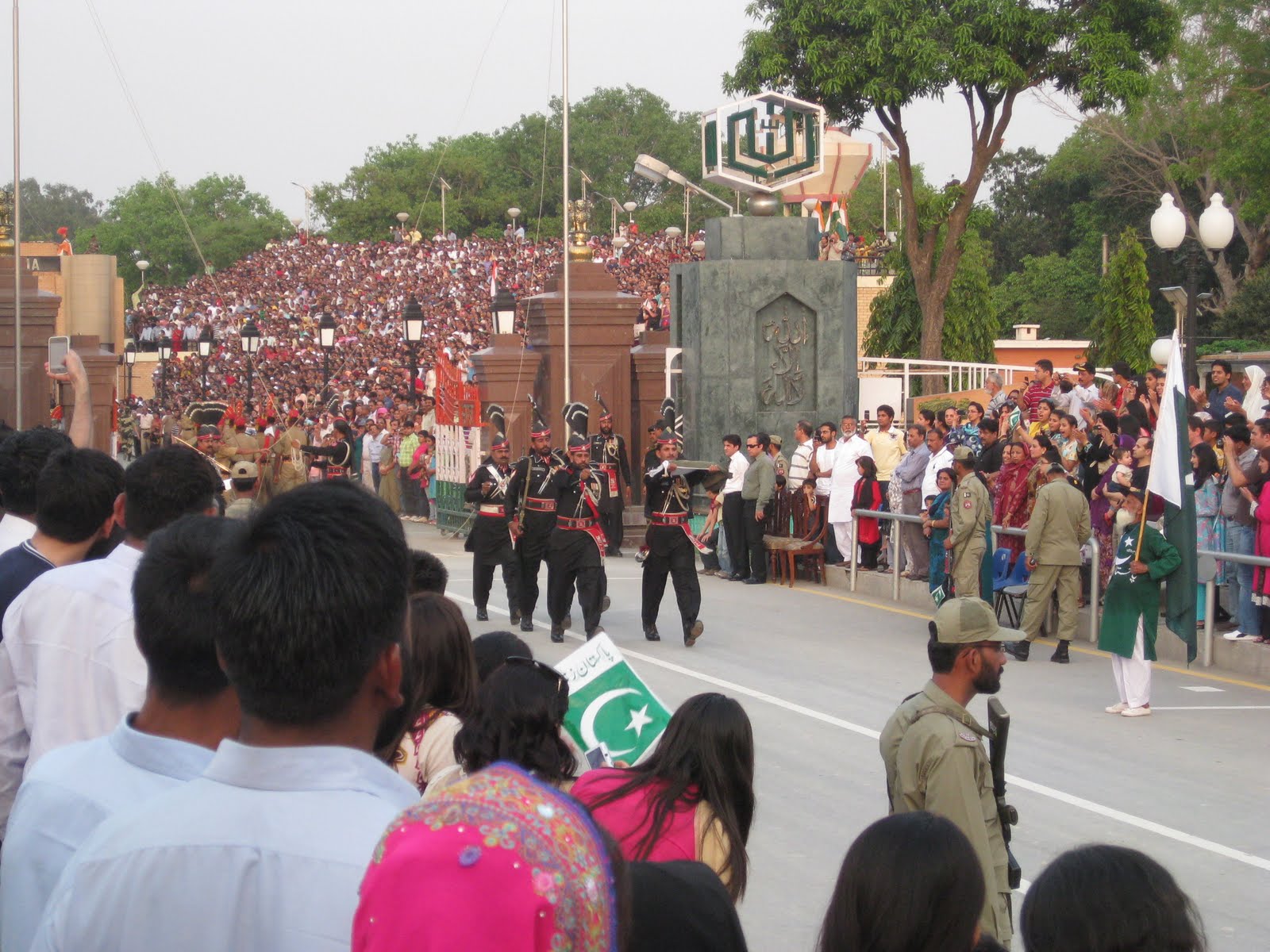
| Border ceremony at Wagah. |
Next day, we insist on going to Wagah (30 km from Lahore) to see the border ceremony. This is the only legal crossing between India and Pakistan which according to the Economist is the world’s most dangerous border. Loud music, plastic flags given to our hands, crowds from every age, cheerleader like men to lead the crowds, an amazing ritual of flags taken down, Indian and Pakistani soldiers dressed up same but in different color walking in a kick like walk towards each other while we shout with our Pakistan flags. While we totally embarrass our hosts, we are amazed that this ritual is repeated EVERY DAY! It is a sight not to be missed and makes me think that I will never ever complain about nationalism in my country.
 |
| Border ceremony at Wagah. |
On our return to the city, we eat at Cooco’s Den in Heera Mandi. Not only it is an interesting building, it has an amazing view of the Badshahi mosque at night and the food is AMAZING! For more see: .
Notice that alcohol is not served in restaurants in Pakistan but in hotels, it is available. So, we enjoyed Pakistani whisky and beer (brewed in Rawalpindi).
 |
| The gate is now open at Wagah. |
 |
| The flags are coming down at Wagah. |
As I head to the airport at 2 am in the morning, I see people using the road, fields and all flat empty spaces to play cricket. I then remember that Imran Khan is the national hero of this cricket crazed country. Colorful, troubled and full of paradoxes, one trip appears totally not enough to unravel its secrets. There is a chance that I might give consultancy to colleagues in Pakistan which means I might come back sooner than I think. Despite the short visit, I totally admired people’s sense of humor despite all the troubles in the country: Are all marriages arranged in Pakistan?. “Yes, some rather badly”. (*Special thanks to KA for the joke, that made it to the title).
 |
| Going, going, gone in Wagah. |
 |
| Mission accomplished, flag taken down and back at Wagah. |
 |
| View from Cooco's Den towards Badshahi Mosque. |