Showing posts with label Istanbul. Show all posts

Mar 12, 2012

Once a harbour always a harbour: Karaköy, Istanbul


As the Taksim-Beyoğlu stretch of Istanbul fills by the day and Galata becomes home to fashionistas, in need of new cool spaces, developers move further down. They arrive no other place than Karaköy which for years was a bustling commercial centre and harbor. Anyone familiar with the significance of the neighborhood since Ottoman times is probably not surprised given its prime location but this may also have to do with harbors' amazing capacity to reinvent themselves in general. 


The Arab Mosque under renovation in Istanbul.

A close up of the Arab Mosque's tower, Istanbul.
Picture: Innes Welbourne.


Although some of the old buildings in Karaköy decayed when the skyscrapers have become the norm for banks, and businesses moved outside the city, the current revival makes sure that the buildings have their best days ahead as evident with the opening of Salt Galata while some will be converted to boutique hotels. Located on Bankalar Caddesi (literally "Banks Street"-yes this was the capital of commercial banking in Ottoman times), the building hosts the museum of the Ottoman Bank, the formerly central bank in Turkey and has amazing collection of old stocks, bonds and safes from 19th century. Designed by French architect Vallaury, the building is a tribute to its location on the fringes of the Old and New City, the Golden Horn side that faces the Muslim part of the city has an Oriental architecture while the Banks Street facing Jewish and Christian bankers' neighborhood Galata is Neoclassical. Even when you enter the building, there is a Latin script on the right hand side and Ottoman script on the left. Its restaurant has great views to the Golden Horn.

Karaköy shore with tea drinkers in the park overseeing
the Galata Bridge in Istanbul.


Chains, ropes and others... Karaköy still caters to the needs
 of seafarers that anchor in the harbor such as cruiseships.


Leaving Salt Galata and walking towards the Golden Horn, on your right you can see the Arab Mosque, currently under renovation. As evident in its Genovese style, it is the only Gothic church in the city that remains from the era before the Conquest of Istanbul. Then outside the walls of Constantinople, and home to various Christian colonies, the Karaköy region was exchanged between Arabs and Latins many times, hence the name and its later conversion to a mosque. Now cross the main street and pass by stores that still cater to all the needs of sailors. When I say "all", I mean this literally: even Istanbul's official bordello is located in Karaköy. This is also where you can get yellow fever shots for sailors as well as international travellers such as myself.


Sokollu Mehmet Pasha mosque in Azapkapı, Istanbul.


Looking over to Süleymaniye Mosque from the windows
of Sokollu Mehmet Pasha mosque.
Photo: Innes Welbourne.


The interiors of the Sokollu Mehmet Pasha
mosque in Istanbul are tastefully thought
over by Architecht Sinan.
Photos: Innes Welbourne.


Once you are by the Golden Horn, witness the joy of fishermen and people in the park sipping tea and walk towards another interesting building to visit. This is the Great Architect Sinan in 1578 built Azapkapı Sokollu Mehmet Pasha mosque. Located right on the leg of the second bridge crossing the Golden Horn, it is named after the important statesman of the 16th century in the Ottoman Empire. However, its importance stems from the fact that it was built in the master stage of the great architect and overlooks its other master piece the Süleymaniye mosque. This mosque lacks an alley. One enters it through a door which requires one to climb up the stairs. And if you are lucky to visit in a sunny afternoon, enjoy the sun that fills the mosque's interiors with amazing light games.


Anyone who lived the 70s in Turkey can remember
the sign of phone booths all over the city,
now sold at Bej's store in Istanbul.


View from Cafe Bej in Karaköy, Istanbul.
You must now be fed up with the traffic and chaos of the shops around you. Head now towards Kemankeş Street via the underpass. It can easily be said that the revival of the neighborhood started with the Karaköy Lokantası located here which to this date remains my favorite restaurant in the city. If you are hungry, indulge in its mezes but if you just want a drink and a snack, Cafe Bej a hundred meters down, should be enough for you. In the worst case, engulfed by the nostalgia of a commercial harbour turning into a passenger harbour, you can turn into objects from 1970s Turkey sold in its store. For sure, Karaköy will continue to surprise and reinvent itself.

Feb 3, 2012

Istanbul was Constantinople


Just like the song said it, Istanbul was once Constantinople. As the expansion of the subway and its construction contributes to archeologists' discovery of new segments in the city’s terraine, such as the 1600 years old harbour of Theodosius (see), remember that this is not even the lowest segment (which is neolithic). One level above, the Greek/Byzantium segment is often neglected despite the fact that after the division of Roman Empire to East and West, Istanbul served as the capital of Eastern Roman Empire for centuries. As such, it carried a civilization to full lengths and even served as the birth place of Codex Iustinianus or more generally known as Corpus Iuris Civilis, the foundation document of western legal tradition. Travellers to Istanbul, on the other hand, learn about Byzantine times in the city merely through the Emperor Iustinianus built Saint Sophia. While it and St. Choir Church are considered the most important buildings dating from Byzantium, other buildings standing against the destruction of earthquakes and time also attest to a different Istanbul. This not only fills the city with a different history, tradition and color but has also served as inspiration for the Ottomans who did not hesitate to adopt Byzantine ways to do things while also engaging in rivalry with them.

Church of Pantokrator (Zeyrek Church mosque)
in Istanbul, under renovation.

In that sense, Church of Pantokrator (Zeyrek Church Mosque) is one of the most important buildings of the Byzantine era of the city. Located between Fatih and Süleymaniye hills,  it is a church complex dating from the Middle Byzantine period. Built in the 12th century, it formed part of a monastery and is the largest standing church after Hagia Sophia. Its garden hosts the tombs of various Byzantine emperors. During the Latin invasion of the city, it was even held by Venetians. After the Turkish conquest, it was converted to a mosque and is currently under renovation. After visiting, sit down and enjoy the view to Golden Horn and Süleymaniye Mosque and the food at Zeyrekhane.

Holy water of Ayios Haralambos in Istanbul.

As the protector of sailors, the entrance of
St. Nicholas church in Golden Horn, Istanbul.

Inside the St. Nicholas church in Istanbul.


Down below the Church of Pantokrator, when walking along side the Golden Horn, one can notice the Church of Aya Nikola in Cibali. This church is built on an ayazma (holy water) that is 1000 years old. Because Golden Horn is a natural harbor, especially before the building of bridges over it, the area had many sailors. It is therefore not a suprise that the church is dedicated to te Saint of sailors Nicholas, as seen from the chandeliers shaped like a boat. The church also has copies of sultan edicts on its walls. Unfortunately, it is open only on feast days.

The St. Theodosia church (Gül Camii) in Istanbul.

The interiors of the St. Theodosia church cry out
for renovation.


Close to it but inside the City Walls, is another building from the Middle Byzantine period that is full of mystery. This is the Saint Theodosia Church or the Gül (Rose) Mosque. Dedicated to an iconophile saint -Theodosia- who was martyred by the iconoclasts, her feast is celebrated on 29th May. This day coincides with the fall of Istanbul to Turkish hands. It is said that when the Turks entered the city walls, they saw that the church was covered with roses put up for the Feast of St. Theodosia. Hence, its new name in Turkish “the mosque of rose”. While the building was converted to a mosque during Ottoman rule, it is stil an eclectic building given its original design as a Greek cross with added Ottoman columns from 16th century and its interiors being decorated with stars of David to protect it from evil eyes. Rumor has it that some Byzantine dynasties were buried here. The Ottomans continued the tradition and buried some of theirs as well. 

The fairy tale building of Fener Greek Highschool
in Istanbul.

The unassuming exteriors of the church of Panagia Moukhliotissa
in Istanbul (cameras  not allowed inside).

The view to Golden Horn from Fener Greek Highschool.

Picture on the walls of Greek highschool with
Sultan handing the edict for the school.


Moving up, the Church of Panagia Moukhliotissa in Fener can be considered a real treasure for it is the only church which has remained as a church since the conquest. Never converted to a mosque and established by Byzantine Princess Maria in the 13th century, it also remains the only church in town with a clover leaf design. It is sometimes referred as the  “bloody church” because of the bloody battles around the then Greek neighborhood of Phanarion (Fener) during the Conquest of Istanbul. Taking its name from a light house in Golden Horn, it was one of the richest neighborhoods of the time. High bureaucrats such as translators lived there. It is also home to famous musician and statesman Dmitry Cantemir whose house is still standing. Another important building in the neighborhood is the Fener Greek Highschool. Built in 1881 by architect Dimadis with Marseille red brick, it looks like a fairy tale building and often mistaken for the nearby Greek Patriarchy. Unfortunately, the number of students in it is in historically low numbers given Turkey’s successful (!) policy towards Christian minorities (follow label Gokceada in this blog to learn more).

Streets of once rich Fener district in Istanbul.

Aya Yorgi church at Greek Patriarch in Istanbul.


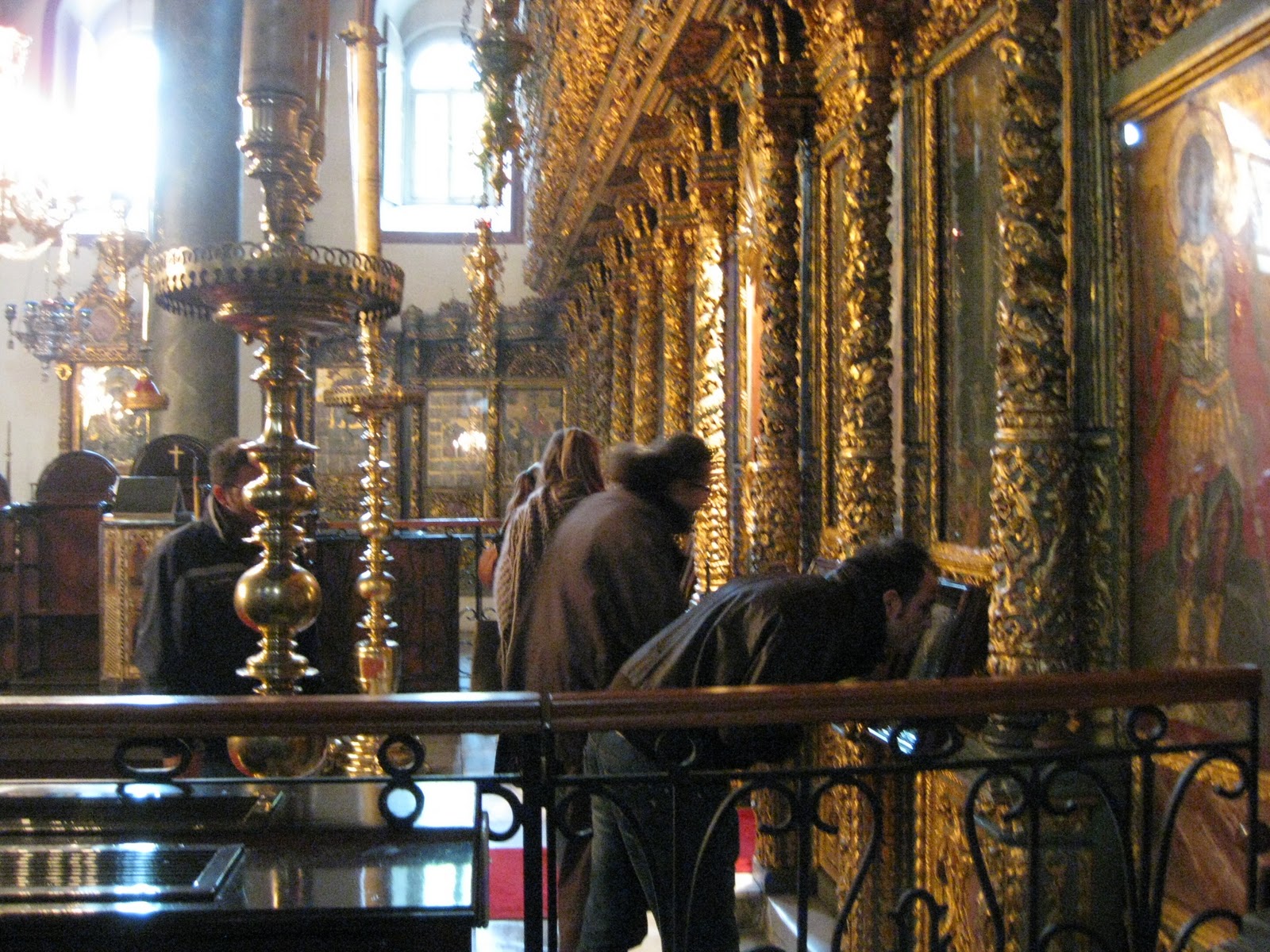
Interior of the church of the Greek Patriarch in Istanbul,
icono wall covered with gold.

A piece from the marble where Jesus was beaten
before crucification was brought to the
Greek Patriarch in Istanbul.


Also located in the vicinity is the Greek Patriarchy, one of the oldest institutions in the world –older than Vatican- and the center of the Greek Orthodoxy. It moved to this location in 1601 and underwent renovation. Curiously, one enters the Patriarchy from its side door because after the execution in 1821 of Patriarch Gregorios 5th who left through the main door, it is kept closed. Its church Aya Yorgi hosts various treasures considered sacred for Orthodox Christiandom. Sometimes rich Greeks get married in the church and all sorts of dignitaries visit it.


The above Panayia Vlahernia Church can be another spot of interest since it appears to be the only Christian place of worship where  mass is held on Fridays given a 1400 years old myth that saved the city from falling into foreign hands. 


Although a little far out and close to St. Choir Church, the Palace of Porphyrogennetus (Tekfur Sarayı) is the last imperial palace of the late Byzantine period in the city. It was not only built into the city walls but also on the highest hill of the city, Edirnekapı. As shown in the above video (accompanied by Ottoman music:-)) it is the only building remaining from the Blakernai palace complex of the time.  Built by Emperor Manuel Komnenos in 12th century for his wife, it is the spot where Mehmet the Conqueror is said to have watched the conquest from. It was used as a workshop for tiles that decorate many mosques in Istanbul. Later used by Jews as a sanctuary, it was abandoned when  damaged by a fire. Today it is under renovation but if you are visiting on a Sunday, after seeing the palace, head to the pigeon  market in Edirnekapı to see pigeon raisers, a truly Eastern phenomenon.  

Inside the church in Greek Patriarch, the tombs of
Omonia, Teophano and Euphemia) in Istanbul.


The main door of the Greek Patriarch
 in Istanbul remains closed after the "incident".


You can lit a candle or write a wish at
Panayia Vlahernia Church in Istanbul.


Considering all this, one wonders why the Greek-Byzantium past of the city is so underplayed and its Ottoman-Muslim side emphasized. Do the lyrics of the song has an answer? "So take me back to Constantinople. Being long time gone Constantinople. Why did Constantinole get the works? That's nobody's business but the Turks". Hardly.

Nov 27, 2011

Arrow to Turk, sword to Samurai


Defense, sports and poetry coming together and then disappearing in the period of the Turkish modernization? I am talking about the archery tradition in Turkey that developed very different than in the West. It was first used by Turks as an offensive weapon given the nomadic life on horseback in their homeland of Central Asia. With the advance of firearms, however, its offensive function faded away in the 17th century. Nevertheless, the Turks were the first in history that practiced recreational and sportive archery (flight shooting). For that purpose, they established okmeidans (literally meaning “square of arrow”) in Edirne and Bursa, the capitals of the Ottoman Empire in 15th century.

Urban "development" is endangering the remaining archery stones.

Fine example of an archery stone in Okmeydanı, Istanbul.

Notice the arrows on the top of the archery stone
built for the success of Mahmut II, Istanbul.
A postcard from 19th century showing the same stone of Mahmut II.
(Special thanks to TT.)

Turks' methods of archery were so advanced that in target shooting they could shoot as far as 165-250 meters while in distance shooting they reached 600 meters. If one bares in mind that today in the Olympics the distance shotting range is 70-90 meters, one can understand their sophistication. Indeed, archery was practiced on the basis of a guild system that required a license to shoot in certain ranges. For instance, in order to be able to shoot in Okmeydanı, a license had to be obtained first which would be issued only if someone could  already reach 594 m.

Another stone soon to fall victim to urban "development" in Istanbul.


Shooting was practiced in sects where Sufism, mystic principles in Islam, reigned. There were also other rituals. A record was commemorated with an archery stone erected in the name of the archer in the presence of witnesses. Further, the stone would include a poem reciting the weather conditions and other praise. Just like surfers wait for certain kinds of wind, archers also did. Golden Horn as a natural harbor allowed a micro climate to form around it, its hilltop district Okmeydani therefore become the location of choice for archers. The stones around the district thus erected contain pieces of poetry on them. While they can be seen as pieces of art they also document the history of sports visible also in previous Ottoman spheres of influence such as Cairo, Skopje, Belgrade, Sofia and Haleppo. For more: click here.


This archery stone built by Selim III is located in Aynalıkavak
and is overlooking the Golden Horn in Istanbul.


A poem by Sultan Selim III (using nickname Ilhami).

Examples of Turkish bows in Military Museum in Istanbul.


All these practices are documented in the reports of ambassadors as well as miniatures that depict archery skills such as Partian shot (done by turning back while riding a horse). In fact, Sultans themselves were archers: especially Mehmet the Conqueror and Mahmut II as evinced by many stones erected in his name. However, sultans also had to respect the guild tradition. In the 19th century, archery began to slowly fade out but its seal of death was the closing of all sects with the Republic.


The miniature depicting the famous Partian shot
done by turning back while riding a horse.

Today, no one is qualified enough to obtain a license let alone reach past glories of shooting over 800 meters. Okmeydanı, a square full of records, is under the threat of urban development. From the 300 or so stones today there are only 26 left. While the old sect building is being renovated and a museum dedicated to archery will be established in it, the remaining stones in the neighborhood will be removed to the museum to save them from further destruction. Meanwhile, the Military Museum in Istanbul and the Topkapı Palace Weapons collection seem to have a good collection  of arrows while the courtyard of the mosque in Teşvikiye houses stones of Selim III and Mahmut II in protected environments. The tradition lives only with street names in Istanbul such as "Kemankeş" (archer) or in the language with sayings such as: “dikili bir taşım yok” (I do not even have a stone erected on my name); “kemankeşe bir söz yeter” (one word is enough for the archer), “ok yaydan çıktı” (the arrow is out of the bow). Samurais wouldn’t approve of that.

Special thanks to Fest Turizm. For more on archery, click here.

Nov 13, 2011

The raid of Sublime Porte and my moment of truth


The governor's building in Istanbul, the former Sublime Porte.


The Sublime Porte, the offices that formed part of the administration in the Ottoman Empire serve today as the office of the Governor of Istanbul. Located in the heart of the Old City, the building is closed to visits by the public but thanks to a tour that allowed access to a few privileged, I was able to see few rooms that have been opened for us. While we were admiring the newly renovated building, I realized I stood in a historically important room that was raided in 1913.

Reception room of the Sublime Porte in Istanbul.

The office desk of Prime Minister Cevat Pasha (1881-95).

The banquets at the governor's office in Istanbul are held here.


The victims of the raid were various pashas and ministers who were in a meeting when killed at gunpoint. The pretext for the raid was their failure in the Balkan War which lead to the loss of important Balkan territory of the Empire. Raiders, on the other hand, were members of the Committee of Union and Progress. According to some, they were power hungry self-appointed military men who started terrible traditions in Turkey such as military coups (the raid can be called one) among other things. According to others, they were patriots who would do anything to save their country. The fact that Atatürk (as the founder of modern Turkey) as well as the heroes of the War of Independence were former members of the Committee contributes to this perception.


The offices of the governor in Istanbul as recently renovated.


The perception gap between the two versions of the Committee notwithstanding, the raid in the Sublime Porte had important political consequences for Turkey. After the raid until the end of the First World War, the Committee (and not the Sultan) controlled the Ottoman government. Some of the decisions it took in militaristic style led to many disasters that remain controversial today such as the Armenian Genocide as well as the decision to join the First World War which led to the ruin of the Empire. In the end, two main figures of the raid (Enver and Talat Pashas) had to flee the country and the latter was assasinated by an Armenian. Their remains were brought to Turkey in 1948 and 1996 respectively.

One of the walls at the Monument of Liberty in Caglayan, Istanbul
dedicated to the Ottoman constitution of 1877.

The grave of Enver Pasa by the Monument of Liberty in Istanbul.

The Monument of Liberty in Istanbul at Caglayan.

The grave of Talat Pasha at Monument of Liberty in Istanbul.


At the time of the visit, all this passed through my mind without a second thought. However, my moment of truth came a month later when I saw where the two men were buried. It was in Caglayan neighborhood of Istanbul by the Monument of Liberty erected to commemorate the dead that fought off what was claimed to be a religious uprising. Interestingly, the two men had other dignitaries as neighbors whose remains were also brought from far away places. First to mention is Midhat Pasha, the drafter of the Ottoman constitution of 1877 whose remains were transferred in 1951 from Saudi Arabia where he died in exile. Second is Mahmut Şevket Pasha (and his two bodyguards) who was put by the Committee in charge of government after the raid. Just like Enver and Talat Pashas, he too was later assassinated. There were also other Committee members.


Another Committe dignitary hailing from the Balkans,
Ohrid (today's FYROM) at the Monument of Liberty.

Mahmut Shevket Pasha's grave who was appointed
by the Committe after the raid.

The newly built court house of Istanbul right behind the
Monument of Liberty in Istanbul.

While this probably explains to which view of the Committee the government of Turkey subscribes, the gigantic new neighbor of the Monument is even more telling: The Palace of Justice of Istanbul. Hailed as the biggest courthouse in Europe by the government, it overlooks the park and the Monument. It almost seems like the justice system is entrusted to the watch of the Committee whose members used to pledge alliance to it with a rifle and Quran. Whether this has any connection with justice let alone liberty is ofcourse another question.