Showing posts with label Armenian. Show all posts

Oct 12, 2013

The Turkish Scotland: Plateaus of the Blacksea

Proudly Turkish in the plateau, Pokut.
Photo: Neslihan Güven

Pokut plateau, at the terasse of Plato'da Mola.

If you are one of those who cannot sit idly on a beach for extended periods of time or have low tolerance for sun, or simply love the nature and hiking, you need to head to the Blacksea region of Turkey. The region is famous for its plateaus, greenery and lately for hiking. In fact, it remains one of the most natural places in the country. In the highlands there are hardly any roads. The plateaus are inaccessible at least 6 months of the year given the constant rain and snow in higher altitudes. In the summer months, it is simply a depot of oxygen.


Plato'da Mola, a chalet at Pokut plateau.

To get there, all you have to do is to fly to Trabzon and take a bus to Ardesen, 20 km. east of Rize. This is also the entry to the Kackarlar Mountain Natural Park. A lot of people drive to Ayder plateau from Ardesen and hike up. We instead were driven through Camlihemsin straight up to the plateau called Pokut, at 2100 metres. We stayed at Plato'da Mola, basically a renovated chalet with five rooms in the middle of the nature. Food is cooked and served inside the 150 years old chalet by the super friendly owners. There is nothing around except the mountains and one is inclined to feel like Heidi and the surroundings in fact feel like the Swiss Alps, if not better. The plateau of Sal is 20 minutes walk away from Pokut and is also an option to stay.

Photo: Neslihan Güven

The road and views to Hazindag from Pokut
with Ares showing the way.

When we wanted to hike, the owners' dog Ares accompanied us to the plateau called Hazindag (the Sad Mountain) two hours away. The 5 km walk was very easy with amazing views. It is possible to continue from here to another plateau called Samistal but spending the night there would be a must. On the way back to Pokut, the fog set in and Ares decided to take us from a longer road (7km). Due to the decreased visiblity, Ares constantly watched us by turning back and making sure we were not lost. The word dog does not do justice to his intellect. 

Photo: Neslihan Güven

Steepy is the byword of the Blacksea region,
at Hazindag plateau.
Photo: Neslihan Güven

The people of the region of Camlihemsin are very proud of their heritage and love the nature. Not surprisingly, they are staunchly against the dam building projects of the government. Their culture is eclectic with Greek, Laz and Armenian tones while their forefathers have gone to Russia for work before the  1917 Revolution. The region seems to have been at the crossroads of many cultures but the names of plateaus remain Armenian: Palovit, Elevit, Tirovit. The last syllabus vit meaning a flat place. Similarly, there are names such as Avusor, Kermukerec, Apevanak or Hacevanak. The plateaus of Ceymakcur or Kotencur give in their last syllabus the Armenian word for water. The owners of the place tell me that they still call cattle for water in Armenian.

Ortan village houses in Blacksea.

The Turkish fondue called muhlama of Blacksea region.

The typical Firtina valley houses of the region,
as viewed from Ortan village.
Photo: Neslihan Güven

The next day we go down to the village of Ortan and stay in another chalet, typical of the region. The road from Ortan to the valley is dotted with street signs bought by somebody from the Roads Authority. Characteristic of the sense of humor of the region, he wrote messages under the signs. No wonder I call the region the Turkish Scotland: rainy and witty:-)

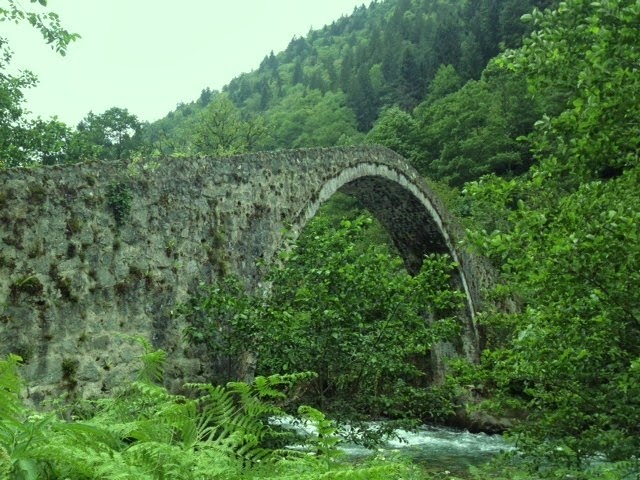
Bridge in Firtina valley.


The Road Authority sign in Ortan says: off you go.


Nov 14, 2012

Tormented by politics in the Dodecanese


For all the gloomy politics and doomsayers of Greece, the Aegean Islands just off the Turkish coast (the Dodecanese -twelve- islands) are still a great escape. It's not only beating the crowds of mainland Turkey that drew Turks there on a long religious holiday. But it is the comfort of feeling at home since the food and the people are very similar. Yet, it is still different given the religion, language and architecture, not to mention the inertia that Greeks seem to have adopted towards government and public life in general. In fact, this inertia drove us at times mad as we seem to have increasingly low tolerance for non-customer oriented service mentality. 

View from hotel room at Pedi Bay, Symi, Greece
while Coldplay's Paradise plays in the back.

Kali Strata cafe/bar at Symi Island.

Kali Strata bar's famous cushions at Symi.


One of the most picturesque Dodecanese islands, Symi can be best described as a mixture of Portofino and Dubrovnik. Like all Dodecanese islands, it has an interesting historical heritage: it belonged to Ottomans, Italians and then to Greeks. It is protected by geography: due to the ferry schedule, it takes an entire day even from the hub of the Dodecanese -Kos island- to get there unless you are on a private boat.  The ferry lands right at the clock tower, where we are picked up by our host who drives us to Hotel Taxiarchis located in the quieter Pedi bay. He sais if he knew we were coming from Datça, literally right across Symi on the Turkish side, he could have picked us up by boat:-). Pedi is 15 minutes away from the downtown area of Symi and involves a steep walk but is worth for its views. As we walk down, we spot Kali Strata, a cafe/bar where on the cushion covered steps you can enjoy coffee or better drinks with the sunset while overlooking the yachts at the harbour.

Streets of Symi Island, Greece.


There are many options for dinner in Symi's downtown. We deliberately avoided the huge, crowded and overpriced Manos that greets visitors at its prime location. Instead we ate in the back streets, at Meraklis and Naeira, both of which serve extremely delicious food. Another option at night is to walk to the other bay Kolonaki. Hotel Aliki, an extremely charming boutique hotel, operates a resturant called Vaporetta. We could not eat there but saw two Turkish tycoons doing so with their entourage so we assume it must be good given also the charming looks of the boutique hotel. Very close to Vaporetta is a sea side bar called Tsati, not only romantic but also where waves can wet your feet while you sip your coffee. What ever you eat at Symi, do not miss the Symi shrimps which are small and eaten with their skin and the mastique ice cream.

Symi island, harbour, Greece.
Picture: Sinan Güngör.


Swimming options are good at Symi. One day we walked down to Pedi beach and took a boat to Aya Nikola for €5. Another option was to take a boat tour for €35. You can enjoy excellent beaches such as Aya Yorgi or the Monastery. Indeed, this small island has so many monasteries everywhere. During the boat tour we ran into a Greek man who was originally from Istanbul. He was dying to speak Turkish with us and after small talk, the unavoidable subject of politics surfaced. Our friend had to run away from Turkey in 1978. He told us it was still hurting him to have left home. He told us how he did his military service in Central Anatolia and how he was beaten countless times during it, for being Greek/Christian. He mentioned the notorious "citizen, speak Turkish campaign" and the beatings he witnessed during that time for speaking Greek in public. Because of that, he still felt nervous when speaking Greek in Istanbul. He said he realized that all of this changed now and wanted to know what we had to say to all this. What could we say? Turkey's sins are so overwhelming and widespread, it catches you in unexpected moments like this and torments your soul.

Aya Yorgi beach, Symi Island.


Aya Nikola beach, Symi island.
Picture: Sinan Güngör.

Symi at sunset,
Picture: Sinan Güngör.


Sensing our sadness, our friend started criticizing the boat owner for serving ouzo without water melon, a must in Turkey. "These Greeks cannot learn this!", he said in desparation. He also complained about his second wife, from mainland Greece as opposed to his first Greek wife from Istanbul. Except the language and the religion, there were no similarities between them. Besides, mainland Greeks were not religious enough. Whether Turks could contribute to the Greek economy by visiting more? We said that only when the visa was lifted. He added: "we do not want the headscarfed ones though". It was so interesting to note how his identity shifted back and forth during the conversation, finally ending with the Kemalist Turkish one:-).

Views from Aegean Tavern, Kalymnos island, Greece.


Telendos rising as viewed from Kalymnos.


Next day, we headed to Kalymnos which is not as picturesque as Symi but is a sponge island and is one of the best rock climbing spots of Europe. We stayed in the back of the island at Myrties Beach with a wonderful view to Telendos island that was rising like a volcano. Without the breakfast our newly renovated room cost €40. Turks never sat foot on this island but only taxed it while Germans seem to have occupied it during the Second World War. It joined Greece as late as 1948. Due to the recent economic difficulties, about 7000 people seems to have left the island for the United States and Australia. 


This man on Kalymnos says:
"we were Italian once".


Kalymnos island is full of sponge shops like this.


In the two nights we stayed in Kalymnos, we dined at Aegean Tavern at the Massouri beach. The mezes, main courses, price, decoration, view and service were excellent. Amid this atmosphere, just like in Symi, we were all of a sudden again faced with politics when our waiter started speaking Turkish with us. He was from Lebanon but his family's origins were in Adana (southern Turkey). In other words, he was Armenian. I figured that his family must have escaped either during the pogrom in 1909 or the genocide in 1915 but he was graceful enough not to mention all this and to just put it as: "my family is from Adana". In fact, he may not have spoken Turkish with us and revealed his identity. But just like the Greek guy from Istanbul, he was dying to speak with us. Is this a version of the Stockholm syndrome I wondered. I am unsure whether I would continue speaking the language of the country that my forefathers have been kicked out with no apology or compensation after almost 100 years. After these two incidents that just bursted in the middle of my Dodecanese phantasies, I wonder whether there may be any peace or an escape from politics for a Turk. Maybe not. Maybe there shouldn't be until we can do more than bowing our head in shame. 

Nov 13, 2011

The raid of Sublime Porte and my moment of truth


The governor's building in Istanbul, the former Sublime Porte.


The Sublime Porte, the offices that formed part of the administration in the Ottoman Empire serve today as the office of the Governor of Istanbul. Located in the heart of the Old City, the building is closed to visits by the public but thanks to a tour that allowed access to a few privileged, I was able to see few rooms that have been opened for us. While we were admiring the newly renovated building, I realized I stood in a historically important room that was raided in 1913.

Reception room of the Sublime Porte in Istanbul.

The office desk of Prime Minister Cevat Pasha (1881-95).

The banquets at the governor's office in Istanbul are held here.


The victims of the raid were various pashas and ministers who were in a meeting when killed at gunpoint. The pretext for the raid was their failure in the Balkan War which lead to the loss of important Balkan territory of the Empire. Raiders, on the other hand, were members of the Committee of Union and Progress. According to some, they were power hungry self-appointed military men who started terrible traditions in Turkey such as military coups (the raid can be called one) among other things. According to others, they were patriots who would do anything to save their country. The fact that Atatürk (as the founder of modern Turkey) as well as the heroes of the War of Independence were former members of the Committee contributes to this perception.


The offices of the governor in Istanbul as recently renovated.


The perception gap between the two versions of the Committee notwithstanding, the raid in the Sublime Porte had important political consequences for Turkey. After the raid until the end of the First World War, the Committee (and not the Sultan) controlled the Ottoman government. Some of the decisions it took in militaristic style led to many disasters that remain controversial today such as the Armenian Genocide as well as the decision to join the First World War which led to the ruin of the Empire. In the end, two main figures of the raid (Enver and Talat Pashas) had to flee the country and the latter was assasinated by an Armenian. Their remains were brought to Turkey in 1948 and 1996 respectively.

One of the walls at the Monument of Liberty in Caglayan, Istanbul
dedicated to the Ottoman constitution of 1877.

The grave of Enver Pasa by the Monument of Liberty in Istanbul.

The Monument of Liberty in Istanbul at Caglayan.

The grave of Talat Pasha at Monument of Liberty in Istanbul.


At the time of the visit, all this passed through my mind without a second thought. However, my moment of truth came a month later when I saw where the two men were buried. It was in Caglayan neighborhood of Istanbul by the Monument of Liberty erected to commemorate the dead that fought off what was claimed to be a religious uprising. Interestingly, the two men had other dignitaries as neighbors whose remains were also brought from far away places. First to mention is Midhat Pasha, the drafter of the Ottoman constitution of 1877 whose remains were transferred in 1951 from Saudi Arabia where he died in exile. Second is Mahmut Şevket Pasha (and his two bodyguards) who was put by the Committee in charge of government after the raid. Just like Enver and Talat Pashas, he too was later assassinated. There were also other Committee members.


Another Committe dignitary hailing from the Balkans,
Ohrid (today's FYROM) at the Monument of Liberty.

Mahmut Shevket Pasha's grave who was appointed
by the Committe after the raid.

The newly built court house of Istanbul right behind the
Monument of Liberty in Istanbul.

While this probably explains to which view of the Committee the government of Turkey subscribes, the gigantic new neighbor of the Monument is even more telling: The Palace of Justice of Istanbul. Hailed as the biggest courthouse in Europe by the government, it overlooks the park and the Monument. It almost seems like the justice system is entrusted to the watch of the Committee whose members used to pledge alliance to it with a rifle and Quran. Whether this has any connection with justice let alone liberty is ofcourse another question. 

Feb 27, 2011

Little Muscovites in Turkey

At 1800 meters high, in the furthest northeastern part of the Anatolian plateau, totally covered with snow in a vast emptiness, I was one more time taken by my own country that revealed a totally different culture and aura to me. Here I was  in Kars, at the border with Armenia where at one time 19 different ethnicities lived side by side. The first republic of Anatolia (before Republic of Turkey) was also established here although it was a short lived one.  Today it is mostly Kurdish (65%) with Turks and Azeris constituting the largest minority among others.

A view from the Old Town with the Kars river passing through.

This boy from Kars wanted me to put his picture in Facebook.

People from Kars glide on ice and laugh while you barely can take a proper step.
What so struck me was the fact that 40 years of occupation by Russians at the end of nineteenth century left so many 19th century Baltic architecture buildings in the city. (For a city plan in Russian, scroll down). The first time I heard about this heritage was in Nobel winner Orhan Pamuk’s “Snow”. He was describing  events taking place in 3-4 days when the town was cut off by heavy snow from the world. The hero found himself in the middle of political struggles in the city and often walked around decrepit buildings while yearning for love. There was a certain sadness and melancholy accompanying the novel. In Reha Erdem’s “Kosmos”, (for a trailer see http://www.kosmos.com.tr/), this melancholy seemed to be accompanied by the poetic beauty of the snow covering the city. Indeed, Kars seems to have benefited from all this scenery with the former mayor turning it into a movie set.

Another 19th century Baltic style building in Kars: doctors' house.

This is the trade exchange building in Kars, now privately owned.

Otel Ferah in Kars in which Pamuk's Snow is taking place.
Photo: Zeren Göktan.
Turkish politics recently handed another landmark to Kars. Prime minister Erdoğan during the commemoration of the dead soldiers of the First World War in nearby Sarıkamış numbering around 90.000, looked up to the citadel and called a newly erected statue as “monstrosity” and ordered its demolition. It was designed by the artist Mehmet Aksoy, as a result of a competition for the memory of those soldiers. There has been much debate whether it should be torn down because the PM did not like it. When I was there in February 2011, it was one of the tourist attractions of the city but has been removed piece by piece. So much for art that is not liked by (long live) my Sultan! It has been said that this was a maneuver of the prime minister probably to counter balance the publicity created by the collective prayer of the MHP (Nationalist Action Party)  in the Fethiye Mosque in Ani. Located 45 km from Kars, Ani used to be a big town on the Silk Road in Middle Ages. It also happens to be the place where Turks entered Anatolia in 11th century. The Fethiye (means conquest) Mosque is supposed to be the first place where prayer was held in Anatolia by Turks. Hence, the emphasis of that point by the nationalists.

The twelve Apostils Church in Kars with the Kars castle on the right.

The constitution of the first republic in Anatolia established in Kars.

And the famous, unfinished "monstrosity" in Kars, before its removal.
Photo: Zeren Göktan.
Because it is right at the border with Armenia and partly is in a military zone, Ani remained closed for decades to visit. No doubt Kars will benefit from the opening of the border with Armenia. Even today many Armenians are visiting Ani. Our guide explains the use of dynamite for mining right across the river in Armenia is damaging Ani. Unfortunately, Ani also lies on the North Anatolian fault line which meant it was destructed by earthquakes.

The stone bier of the Fethiye Mosque (to lay the dead) in Kars. Converted from a church,
notice the removal of the vertical peace of the cross.

The interior of the Fethiye Mosque in Kars converted from Aleksander Nevsky Church.

The Fethiye Mosque in Kars at night.
Kars’ economy is based on stock breeding and its cheese and honey are excellent. Recently ski tourism also increased thanks to better air connection. The nearby Sarıkamış has one of the longest  ski-run in Europe and very good quality snow. In the town itself, there is the 12 apostils church which bares the clear hallmarks of Armenian architecture. Along the river there is a Turkish bath and old houses such as Ahmet Tevfik Paşa Palace and on top the castle of Kars. Another interesting building is the former Aleksander Nevsky Church which is today the Fethiye mosque. It was originally built as an army base during the Ottoman-Russian War.

A view from Kars streets.

University of Caucasia, Department of Political Science in Kars.

This square in Kars is covered with typical Baltic style buildings with the one
on the right being the Mayor's residence.
The newly opened University of Caucasia must also be mentioned as it pulls students to the town, contributing to the economy. Built in the beautiful Baltic architecture, the political science department of the university is where political prisoners used to be held in appalling conditions during the military rule in 1980-3. One man, Cemal Kırbayır, is said to have notoriously “disappeared” from here. His 103 year old mother Berfo, recently met prime minister Erdoğan to discuss his whereabouts and other disappearances that have happened in the past. It has been recently confirmed to her by a Parliamentary Commission that it is certain that he died in the hand of the military regime. Today, in the same building, political science students, learn “on site” about power, state and civil society where once the former two were plenty while the latter none. Now, that’s what I call the irony of history:-).

KAMER restaurant in Kars, run by women for victims of domestic violence.


A barber store in Kars.
Photo: Zeren Göktan.

Ahmet Tevfik Paşa Palace in Kars.
Photo: Zeren Göktan.
Not only the architecture but also the politics of the town bore a Russian mark: it voted left in a neighborhood of Turkey with clear conservative tendencies. Indeed people from Kars proudly tell you about the city’s tolerant attitude. In such a small town, restaurants remain open in Ramadan or non fasting people freely smoke in public, something you do not see in 150 km away Erzurum. “Erzurum strangles us when we need to go there. We cannot wait to get back”. No wonder they used to call Kars “little Moscow”. However, with the shift of Kurdish politics from left, Kars no longer votes left. It has one MP from MHP and two from Prime Minister’s AKP, hence the political shows about the statue and the collective prayer from both parties:-).


View from Ani, Kars.
Photo: Zeren Göktan.

View from Ani, Kars.
Picture: Zeren Göktan.

Manuşehr (moon faced) Mosque on the very left in Ani is the first Turkish mosque in Anatolia.
The Fethiye Mosque in the middle is the spot of collective prayer by MHP.


Arpaçay river in Ani, forming the Turkey-Armenia border, Turkey on the left.
When in Kars, you should taste the famous goose, salty but yummy. I would also recommend the KAMER restaurant which is run by women. Its income supports a shelter for women escaping from domestic violence. I tasted “hengel” which can be best described as ravioli without meat.  If you have time, what could make your experience a truly different one would be to take the train to Kars. If not, it is one and half hours of flight from Istanbul. Try staying in Kars’ only boutique hotel Kar's. I would truly hope that the now decrepit Ferah Hotel mentioned in Pamuk’s snow is soon restored. And do not forget to take your camera, small amount of brandy, and warm boots and explore the city on foot at night for a truly romantic experience. The dim lights, the lonely streets, the light reflected from the snow is otherworldly.
On the way to Sarıkamış, these men ride horses without saddle to train them.

And these horses in Kars slide on ice and still carry people.
A shorter version of this post is available at Hurriyet Daily News.