Showing posts with label Blacksea. Show all posts

Sep 16, 2014

Stand out of Sinop's sunlight


Inceburun lighthouse in Sinop,
the furthest northern point in Turkey.

Sunset view from Sinop's fort.


One of the nicest things about being in Sinop was to remember –yet again- how big and diverse this country is. Located on the Mid-Blacksea coast of Turkey, it is as underrated as Denizli and definitely worth a weekend visit. Interestingly, it is the happiest town in Turkey when in world happiness indexes, Turks are close to the gloomy part of the list, (77th among 156 countries). One of the contributing factors to this happiness may well be that they might know how to live with the least number of things available. Indeed, Diogenes who famously lived in a jar was of Sinop (then Sinope). When asked by the Great Alexander what he could do for him, he famously have said: "stand out of my sunlight". 


All sorts of fish are freshly available
at Sinop.

Fjord like Hamsilos bay in Sinop.

Akliman Bay in Sinop.

Another explanation for the happiness may be the fact that it is in the furthest northern part of the country with the highest amount of sun light. Indeed, a visit to the light house in Inceburun -the furthest northern tip- is a must. It is one of the fewest places in the world where the sun goes up from the sea to also set into the sea. The easiest way to do that is to rent a car or drive to Sinop. When you head out of town towards the direction of the airport, İnceburun, Akliman and Hamsilos are all in the same direction. Hamsilos with its fjord like shape may also serve as the entry point into a hiking trail that is full of endemic birds. Indeed, natural tourism may easily grow in the area given the waterfalls in Erfelek; lake in Ayancik; natural park at Hamsilos and otters under threat of extinction in the area. There are already tour companies that offer it.

Meydankapi mosaics at Sinop archeological museum.


Another view from the mosaics at museum
of archeology in Sinop.
The Fountain of Martyrs at Yalı Kahvesi, Sinop.


The sea, fish and everyhting sea related is in the soul of Sinop. When the fishing prohibition is lifted as of 1 September, fish shops are full, for affordable prices. And restaurants know how to cook it. Fishermen sit around in Meydan Mahallesi and sometimes at Yalı Kahvesi. The latter is a place for everyone to sip tea or coffee and maybe eat a toast. Its humble ways should not fool you as a fountain nearby attests to its historical significance. Indeed, being the shipyard town and port for the Ottoman Navy came at a price for Sinop. When the Ottomans were "the sick man of Europe", the Russians raided the town in 1853 -known as the Battle of Sinop -as part of the Crimean War. Today, the monument for the fallen soldiers is located in the museum of archeology but at Yalı Kahvesi, the re is a fountain commemorating the event. The Fountain of the Martyrs was built with the moneys left in the pockets of the fallen soldiers. Apparently, the Pasha bastions -first built  in the 15th century- were also not much of help given the denseness of the fog. Today, the bastions are decorated with canons and there is constant sound of shelling in the background that makes it all the more real to imagine. 


Monument for the fallen soldiers
 of Sinop Raid of 1853.

Pasha Bastions in Sinop were first built in 15th century.


Street view from few old houses in Sinop.
If you go to Sinop in the summer, the beaches at Akliman, Karaliman and in the city are clean and thus of the few places in Blacksea coast that is so. Another sea related thing in the city is boat modelling which was initiated by two former inmates that were released from the Sinop Prison. Today, there are many shops but Ayhan Kotra seems to have started it. The other shops are all next to his at Iskele Caddesi. Sinop Prison (Cezaevi) is located next to the fortress by the Blacksea and many political and literary figures in Turkey served time here. Given that location, noone has been able to escape it and many movies have been shot in its alleys and corridors. The prison was closed down in 1999 and serves today as a museum. 


A view from the Sinop Prison (museum) today.

The shape of Sinop is like a peninsula but the locals call it an island. If you have a car, driving it all the way will take you to the other side of the city, amid stunning scenery. Along the way, visit Pasha Bastions and drive up to Boztepe where at low visibility, there is a fog horn that warns seafarers. The sea really is the soul of this city. But you can still indulge in meat and Turkish ravioli at Teyze'nin Yeri.


A view from Ayhan Kotra boat modelling shop.

Oct 12, 2013

The Turkish Scotland: Plateaus of the Blacksea

Proudly Turkish in the plateau, Pokut.
Photo: Neslihan Güven

Pokut plateau, at the terasse of Plato'da Mola.

If you are one of those who cannot sit idly on a beach for extended periods of time or have low tolerance for sun, or simply love the nature and hiking, you need to head to the Blacksea region of Turkey. The region is famous for its plateaus, greenery and lately for hiking. In fact, it remains one of the most natural places in the country. In the highlands there are hardly any roads. The plateaus are inaccessible at least 6 months of the year given the constant rain and snow in higher altitudes. In the summer months, it is simply a depot of oxygen.


Plato'da Mola, a chalet at Pokut plateau.

To get there, all you have to do is to fly to Trabzon and take a bus to Ardesen, 20 km. east of Rize. This is also the entry to the Kackarlar Mountain Natural Park. A lot of people drive to Ayder plateau from Ardesen and hike up. We instead were driven through Camlihemsin straight up to the plateau called Pokut, at 2100 metres. We stayed at Plato'da Mola, basically a renovated chalet with five rooms in the middle of the nature. Food is cooked and served inside the 150 years old chalet by the super friendly owners. There is nothing around except the mountains and one is inclined to feel like Heidi and the surroundings in fact feel like the Swiss Alps, if not better. The plateau of Sal is 20 minutes walk away from Pokut and is also an option to stay.

Photo: Neslihan Güven

The road and views to Hazindag from Pokut
with Ares showing the way.

When we wanted to hike, the owners' dog Ares accompanied us to the plateau called Hazindag (the Sad Mountain) two hours away. The 5 km walk was very easy with amazing views. It is possible to continue from here to another plateau called Samistal but spending the night there would be a must. On the way back to Pokut, the fog set in and Ares decided to take us from a longer road (7km). Due to the decreased visiblity, Ares constantly watched us by turning back and making sure we were not lost. The word dog does not do justice to his intellect. 

Photo: Neslihan Güven

Steepy is the byword of the Blacksea region,
at Hazindag plateau.
Photo: Neslihan Güven

The people of the region of Camlihemsin are very proud of their heritage and love the nature. Not surprisingly, they are staunchly against the dam building projects of the government. Their culture is eclectic with Greek, Laz and Armenian tones while their forefathers have gone to Russia for work before the  1917 Revolution. The region seems to have been at the crossroads of many cultures but the names of plateaus remain Armenian: Palovit, Elevit, Tirovit. The last syllabus vit meaning a flat place. Similarly, there are names such as Avusor, Kermukerec, Apevanak or Hacevanak. The plateaus of Ceymakcur or Kotencur give in their last syllabus the Armenian word for water. The owners of the place tell me that they still call cattle for water in Armenian.

Ortan village houses in Blacksea.

The Turkish fondue called muhlama of Blacksea region.

The typical Firtina valley houses of the region,
as viewed from Ortan village.
Photo: Neslihan Güven

The next day we go down to the village of Ortan and stay in another chalet, typical of the region. The road from Ortan to the valley is dotted with street signs bought by somebody from the Roads Authority. Characteristic of the sense of humor of the region, he wrote messages under the signs. No wonder I call the region the Turkish Scotland: rainy and witty:-)

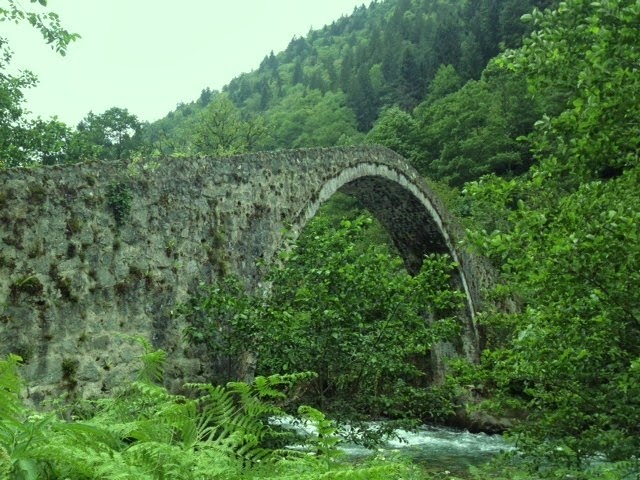
Bridge in Firtina valley.


The Road Authority sign in Ortan says: off you go.


Oct 31, 2010

In the land of tempered people: Eastern Black Sea

All my life long I have been in denial of my Blacksea heritage. All those uncles, aunties, cousins, children of cousins and all other relatives were confusing for me. While I found their unconditional love and support for each other reassuring, their subsequent rage over nothing always scared me. Holding passionate views about everything under the sun, they gave in to nobody. As devoted philanthropists, they knew the right thing to do in every situation and there was no point in arguing with them. Usually calming down in five minutes after thundering, each character seemed very unique and attached to his or her way of doing things. Indeed, people from Blacksea are known for their temper and toting guns in Turkey. It is said that the climate (constant rain) and steep mountains make its people brave and proud as well as challenging. The ones in my family reflected all these qualities to the fullest extent (except the gun part).
Bolaman by the Blacksea in Ordu province, Turkey.
In recent years, holidaying in Black Sea has been associated with hiking in the Kaçkar Mountains and plateaus of Çamlıhemşin. Going to the highland during summer months is the favorite pass time of the region, as humidity on the coast seems to fuel the tempered people’s nerves even more. The solution to avoid full scale war is therefore to go high up to breezier and cooler places to calm down. So this summer I finally decided to face my destiny. My eldest uncle took me and two friends all the way from Ünye (80 km from Samsun Airport) to the Georgian border. The idea was to get to Macahel, the new hot spot in the Black Sea, close to the Georgian border of Turkey while also exploring the coast.

Jason Church at Cape Jason. (in Turkish Yason)

Jason Church and the Eastern Blacksea mountains.
At 72, the uncle is very fit and full of energy. He is the “botanic” man, a grafter and crazy about his trees that he talks about like they are his children, sometimes with their Latin and English names. For instance, if you need to know how many (and what kind) magnolia trees are out there in Istanbul, you need to talk to him. His other qualities include attention to detail; driving buses, cars, trucks and tractors; all main and side roads in Turkey; engines about everything that moves; historical gossip about the owner of the house that we pass by, the clients of this store or the business practices of the residents of a nearby town; collecting wood and old stones from the most obscure places and the like. So if this is your guide, you can only imagine the stories you hear during the trip, sometimes cracking you up, at times bewildering and tiring!

The panorama from Giresun's citadel in Black Sea.

The only island in Black Sea coast as seen from the citadel of Giresun.

Our first stop was Bolaman with its nice beach. It is one of the few places where the Black sea coast road passes inland due to the Cape Jason. Reflecting the typical poor country mentality of building on the coast, this road project not only lasted forever and cost much more than it should, it was also an environmental disaster. It killed the coast line. So one really enjoys what ever is left from the coast, another example of which is the Church Jason right by the sea. This abandoned church today is one of the few reminders of the region’s former Greek residents. Unfortunately, the Greeks in Turkey and Turks in Greece have been exchanged in the 1930s. Over a million of people in both countries had to leave places they were born and lived for centuries. A whole culture was lost. Such practices amount today nothing but ethnic cleansing but were considered legitimate back than to create a homogenous nation state. Bruce Clark's "Twice a stranger" perfectly captures what these people went through.

The monument of Topal Osman at the Citadel of Giresun, outrageous to say the least.
The citadel of Giresun was our next stop with its beautiful panorama of the city and of the only island in Black Sea. When I turned my back to the scenery, however, to my bewilderment, I was greeted by the monument of Topal Osman. Hailing from the town, the monument gratefully acknowledges his “contribution” in the Armenian and Greek exiles (read murder) from the region. What is most bewildering about it, this controversial man was also said to be involved in the assassination of the first leaders of the Turkish Communist Party in 1920. To this day, this event remains in the dark chapters of Turkish political history. Not only that, he was further involved in the assassination of an MP of Trabzon in 1923 who was a known critique of Atatürk in the Parliament. He himself was killed by soldiers who came to detain him.
Frescoes in the St. Sophia Church in Trabzon.

The dome of the Byzantian St. Sophia Church in Trabzon.

Frescoes in the 13th century St. Sophia church in Trabzon.
While I continued questioning the motives for erecting a monument for a man who contributed to the death of multiculturalism in the region, we arrived in Trabzon’s famous St. Sophia Church -recently converted  into a mosque to the furor of its people- with its marvelous Byzantian frescos. Just like other towns in the coast, Trabzon also used to be a multicultural city as evident from the architecture of old buildings in the city as well as prospering from trade. Today it is mostly associated with fervent nationalism. It hit the headlines when it turned out that the assassin of the Armenian journalist Hrant Dink was coming from the town. As another sign of decline, the town is also associated with prostitution from former CIS countries. At the same time, Trabzon also hosts the famous monastery of Sümela that has been recently restored. After decades, a religious ceremony was finally held in it.


St. Sophia Church from outside in Trabzon.
While thinking about all this makes me feel down, the road continues further east and we come to the Laz region. The Laz are an ethnic minority in the region, known for their blondness and big noses as well as humor. There are many Laz jokes in Turkey and although they are the laughing stock of many Turks, the Laz create the best Laz jokes and stories themselves. They have been also seafaring people and constitute most of the ship owners in Turkey as evinced by the number of seamen schools in the region all baring these families’ names. At the same time, the Laz are also famous for falling in love. In every village or town there are young people who elope with someone. After the event, the family will not talk to the kids for some time but after a while the matter is peacefully settled.


Driving up from Borçka to Macahel close to Turkey-Georgia border.


While all this makes one laugh, the Laz are certainly notorious for their taste in building. The handy work of the ingenuous “Laz contractor”, the Black sea coast is an eye soar with terrible apartment blocks despite its green nature. Indeed, the Laz have all kinds of ingenuities. If you think snowboard is a new sport, think again. Lazboard, a harder version of snowboarding -because you do not tie your feet- has been around for 400 years in the region. They also came up with their own Formula One which they call Formu-Laz. 


Collecting tea in the mountains, North Eastern Blacksea, Turkey.
Photo: Zeren Göktan

Borçka Kara Göl in Macahel valley, North-Eastern Turkey.

Road to Macahel valley is full of scenery in Turkey-Georgia border.

Next morning we hit the road and on our way to Macahel, we first visited Karagöl Lake, an incredibly beautiful place which makes you wanna wake up right by it. We then entered the Macahel valley, a place with dirt roads, tough to get to, under snow for six months and cut from the rest of the world. Known for its biodiversity, nature and honey, the valley is a natural wonder. Indeed, we wondered the mountains, the fog and the amazing trees as well as the sound of rivers. The valley consists of six villages and after an arduous ride, one can arrive at the TEMA house in Camili. TEMA’s building here offers a more comfortable stay than what the locals offer in villages. But the TEMA house was already booked. Therefore, we decided to stay in a local pension. Our Georgian speaking hosts were running a family business. Lodging included breakfast and dinner. At night, we could hear locals playing accordion and singing songs in other villages. While the valley is nature wise distinct from the rest of Turkey, culture wise the people also seem to be really laid back unlike the impetuous coastal people. Locals speak Georgian and laugh that they must have been Christian before being Muslim.
Macahel valley villages right across from us in North Eastern Turkey.

Camili village in Macahel valley.
The next day, our guide gave us a tour of all the villages Efeler, Camili, Düzenli and Maralköy. Without him, it would have been very difficult to get around not only because one definitely needs a 4x4 car but also lack of signs makes a local person essential. Tourism is slowly developing as the road to Macahel is being newly built. One can sense that it is only a matter of time until eco tourism takes off in the region. At the same time, one hopes that the bumpy road remains so and protects the place from too much intrusion. For instance, Maralköy had a waterfall but because it rained too much the day before, we could not go there due to too much mud.

Biodiversity and scenery in Macahel valley is amazing.

Macahel valley produces world class honey.

 
Scene from typical Macahel village in North Eastern Turkey.
Photo: Zeren Göktan.

Scene from typical Macahel village in North Eastern Turkey.
Photo: Zeren Göktan.

While our short trip gave as a taste of Macahel in one night, ideally, one should fly directly to Batumi in Georgia, spend some time there and then, rent a 4x4 and spend 2-3 days in the valley. (Non Turkish citizens should inquire about permits since the valley is in a military zone). Alternatively, you can combine your trip to the valley with a drive on the coast like mine, but in that case, be prepared to deal with the ghosts of the past. At the end of the trip I could not help but repeat Nuri Bilge Ceylan’s words:  my beautiful and lonely country that I so passionately love.

Uncle, botanic man (grafter), guide, driver, our everything Orhun Güven.
Photo: Zeren Göktan.

A shorter version of this post is available at Hurriyet Daily News.