Showing posts with label Balkans. Show all posts

Oct 17, 2014

Albania: Ride in a time capsule

Xsamil beach in Albania with Corfu island in the back.


A view of Saranda, Albania.

When the ferry departing Corfu island of Greece lands in Saranda, Albania one feels like riding in a time capsule. Indeed, the town and the promenade were a mixture of Beirut, Kusadası and Kumburgaz (a cheap summer house place in Istanbul) but back in the 1980s. Right across from Italy, and northwest of Greece, one wonders how Albania could remain what it is even today. Politics, as always, is the answer of course but for all the destitute feeling of the barren customs control and run down buildings of the communist era in Saranda, there is a certain naiveness in the air. It is not only the niceness of the people and the good Italian and Greek food for half the price or the barber shop or the barren cultural museum across the street. It is the feeling of being in the Balkans, and meeting Kosovars and Macedonians who have descended to Albanian riviera. Although the roads are full of cars with license plates from Italy and Germany, one quickly realizes those are the locals who migrated for a better life. There are few tourists who want to explore the last frontier in Europe.

Albanian goodies on the beach, Xsamil.

On the way to Lekursi Castle in Saranda shows
Albania in a nutshell: mushrooms and Mercedes.
In fact, Albania appears a much more multicultural country than one would think. There are Greek villages close to the border with Greece clearly identified with their Greek signs as such. Although its population is half Muslim, half Christian, the latter are of various dominations. However, given its totalitarian past, religion is hardly visible as evinced by the few places of worship. In Saranda, I could see one mosque, one church and one synagogue. In fact, on the road to Durres, over 200km, I specificially counted the number of mosques I saw. It was only 11. Religion was so supressed, in 1992 when communism fell, ten thousand people occupied the Ethem Bey mosque in Tirana and demanded that it be opened for worship. The mosque, built in 18th century by the Ottomans is today the symbol of religious freedom in Albania. It has really interesting murals, atypically Muslim art.


Blue Eye, Albania.


View from Skanderbeg Square
in Tirana with the Opera House in the back.


If you want to see Saranda to the full extent, a 2-3 days stay is a must. So is a car. You can spend a day on the long stretch of Xsamili beach but beware that if on a weekend, it may be very crowded. Apparently the most virgin beaches of Europe are around Lukova -28 km from Saranda- with some places only accessible by sea but we did not have time to do that. A visit to the Blue Eye -a natural deep spring water that looks like an eye- is a must. At sunset, go up the Lekursi Castle and enjoy the view with a beer and possibly dinner. If you have time you should also visit the ancient city of Butrint and Gjirokaster (50 km from Saranda) which is a small Ottoman village with a beautiful castle on top. We just saw it from a distance on our way to Tirana.


Ethem Bey mosque in Tirana, Albania.


The interior of the Ethem Bey mosque has these interesting murals
given the representation ban in Islam.
As soon as you go out of Saranda, one is surrounded by a feeling of wilderness. Albania is empty and virgin territory ready to be explored by nature lovers and nothing attests to that than the road to Tirana. The road is curvy, dotted at times with mushrooms, the bunkers that were built by Enver Hoxha. Once in Tirana, visit the Skanderberg Square and especially the Ethem Bey mosque and take a walk around the artificial lake. You'd be surprised by the number of people jogging, walking and chatting. And on the way back, make sure you stroll and go into one of the club/bars in Blloku. It's where the young and the beautiful party at night. Over all, my three days in Albania gave me only a flavor of the country and made me think again how much we don't know our neighbors or the Balkans.

Sunset at the Tirana park's artificial lake, Albania. 

Aug 31, 2014

Limoncello for mastique in Ioanian islands

Kerri caves in Zakynthos.

Bridge to Agios Sostis in Zakynthos, Greece.

Our arrival in Athens was so refreshing. As we walked by TVs at the airport, not seeing Erdogan on every channel was already feeling like liberation. Then we started to look for a place to buy tickets to the bus station, an old man approached us in Turkish. For someone who migrated to Greece 50 years ago from Istanbul, he spoke amazingly well. His reply: "We are the children of the Ottomans, we are Istanbulian". His strong identification with his homeland struck me since he ended up selling lottery tickets at his 70s with barely any teeth in his mouth. Indeed, no matter how Western-forward looking, the Republic of Turkey was a nation state that barely left any breathing space for minorities like him while quiet contrary the Ottomans were in the end a multicultural empire. It seems that no matter what I did, I could not avoid politics in the land of polis and politics. Next, our taxi driver turns out to have lived in New York City, he tells us with his perfect English that he has no political hope for his country. In fact, these men were the epitomes of the crisis ridden, staid Athens. Even on a Saturday, stores were empty and full with for sale/rent signs. Let alone new buildings not being seen, people do not even have new cars. It is like the city is frozen in the 1990s.  

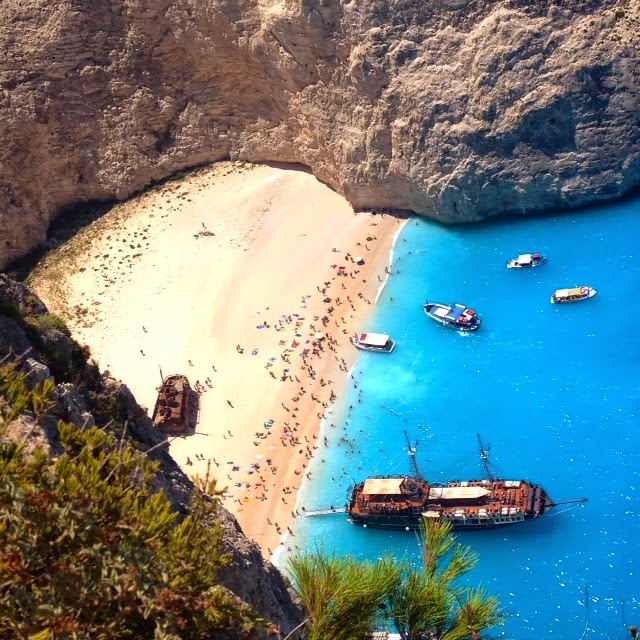
Navago Bay from the top, Zakynthos.

There are various versions as to how the shipwreck
landed here at Navago Bay, Zakynthos.

After this depressing sight, the vibrancy of the Ioanian -the Italian- islands of Greece make a good start for vacation. You should forget about the white and blue typical Greek thing here. Even the names of the islands are Italian like Zante for Zakynthos and Corfu for Kerkyra not to mention Italian delicacies being cooked also well. To get to Zakynthos, taking the bus instead of the flight is not only cheaper but also provides a great opportunity to pass through the Corinth Canal and see the southern shores of the Ioanian Sea dotted with summer houses and cypress and olive trees. After a six hours drive, we arrived at Killini to cross to Zakynthos. It is a huge island so renting a car is a good idea and beware of package tourist filled beaches such as Laganas. This is also where the party crowd is and the main street is filled with Bodrum style clubs and bars. At the same time, the boat trips to see the sea turtles and the Kerri caves also depart from here. If you want some peace and quiet, stay in the southeastern part of the island in Vassilikos like we did. 


A caretta caretta at Laganas, Zakynthos.
Picture: Sinan Güngör.
Corfu looks a little bit like its close neighbor Dubrovnik.
Picture: Sinan Güngör.


Zakynthos is home to one of the most known beaches in Greece: Navagio beach (the Shipwreck Bay). It is in the Northwest part of the island and if you get lost like we did, it might take up to two hours to get to. Nevertheless, the mountain villages of the island make it worth the trip. On the top of the hill where one can take pictures of the bay, there is an incredible line under the burning sun. Unless you are a pro photographer, skip the line and take a shot from the sides. Although the view and the color of the sea look pretty amazing, the spot is packed with tourists. In order to access the beach itself, you will need to go down to Vromi and take a boat. Once you are at the beach, forget about a peaceful stay since there is constant boat approaches and people arriving and leaving. Also, swimming is not that nice since the limestone that gives the sea its incredible blue renders it low visibility. Note that there is not even a single spot to buy any water or drinks. 


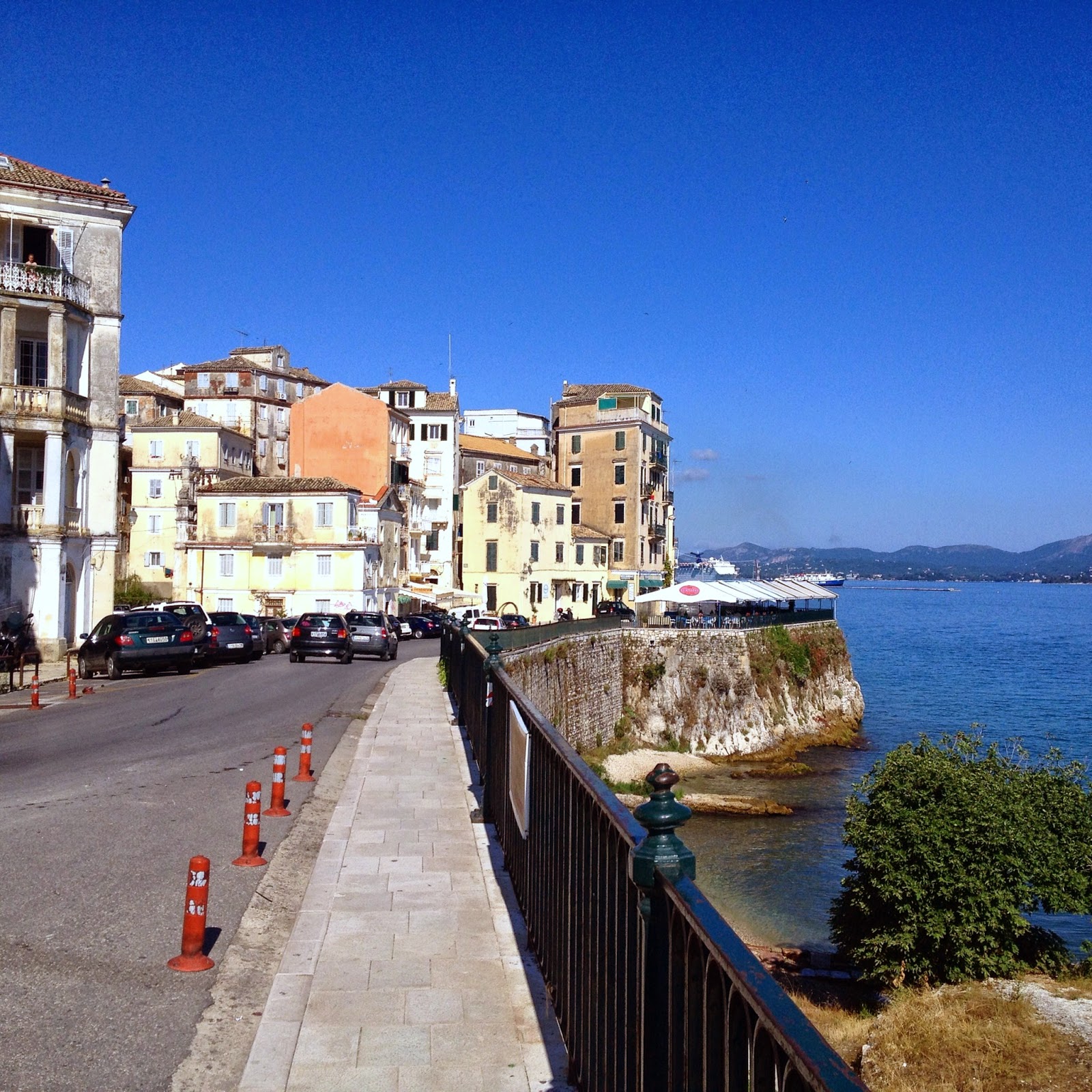
The Esplanade in Corfu town is full of people after sunset.


The food on Zakynthos island is great with usual Greek goodies but try the island rabbit that is cooked with local herbs. If you are in the southeastern side of the island, on the main road Taverna Agnati is superb. And do not be suprised at the Italian touches after dinner such as being served limoncello as appetizer. And for the after hour partying, overlooking Zante town, go to "the Island". 


Catholic outside, notice the tower of the church,
Orthodox inside, Corfu, Greece. 
Kanoni can be spotted from the air
if you are arriving to Corfu by plane.


Of the "Italian islands", the most mixed is probably Corfu, given also the fact that it remained the only Greek soil that did not fall under Turkish occupation. In fact, the Italian -Venetian- influence is very strong starting on the mainland close to Patras, not to mention the islands, even the churches look Catholic from the outside although they are clearly Orthodox inside. Despite the clear Italian influence, Corfu was the place for artists and writers not only of Greek origin as the signs on many houses attest. Its charms are today enjoyed by many more today given its proximity to the Balkans. Indeed, there are many Serbs, Albanians (right across the island), Roumanians and Slovenes that add to the mix and in a way revive who ever has left its prints on the island from the Brits to Russians and French and the Venetians. Its great climate definitly must have contributed to this: it is not burning hot like the Aegean islands and is very green.


Views from Corfu town.


Corfu is huge and is preferebly enjoyed with a car but in the town itself parking and one way streets can be a problem especially in the high season. You should spend some time in Corfu town and enjoy the architecture, the fort and dining in the old establishments such as Rex (fancy great) and Chrisomalis (not fancy, old school great) and newcomers like la Famiglia. Again, these places serve traditional goodies (fish soup) as well as fine Italian ones. For breakfasts -difficult to find- try the le Petit Fleur. Once you are in town, visit also Kanoni, only 1 km from the town. After that, you should try beaches of the island according to your preferences. We mostly stayed in northern and western parts of the island.

Corfu Promenade has romantic views in the evenings.


Glifada and Paleokastritsa are both very nice beaches. However, my favorites were in the northeast of Kerkyra: Kouloura and Kalami where the Durrell House (owned by Durrell brothers Lawrence and Gerard) stood. These are also spots where you can see Albania. In fact, daily tours to Saranda and surroundings are availabale everyday from Corfu town. But then one wonders, it is so peaceful and tasteful here, why bother?

A house in Kouloura, Corfu island, Greece.

Corfu fort, Greece.

Durrell House in Kalami, Corfu.

Special thanks to Sinan Güngör for his important contribution: remembering restaurant names.

Jan 4, 2014

Belgrade is the new Beirut

Fishermen along Sava river, Belgrade.

El Toro, in Hala Beton, Belgrade. 


Having lived in Kosovo for one year right after the NATO bombing campaign, the number one rule when travelling/living in the Balkans is this: Do not discuss politics with anybody. The rule applies stronger if you are from one of the previous occupiers-like myself- unless you want a lengthy history lesson in detail. My hard learned lesson notwithstanding, I could observe that Kosovars' "love to hate the Serbs" attitude immediately softened when the topic was switched to Serbia's capital. Ever since, I thought that if it was an object of admiration even for Kosovars, Belgrade must be really nice. Fulfilling my wish after more than ten years later, I must say it went way above my expectations. 

Kalemegdan Park, Belgrade.


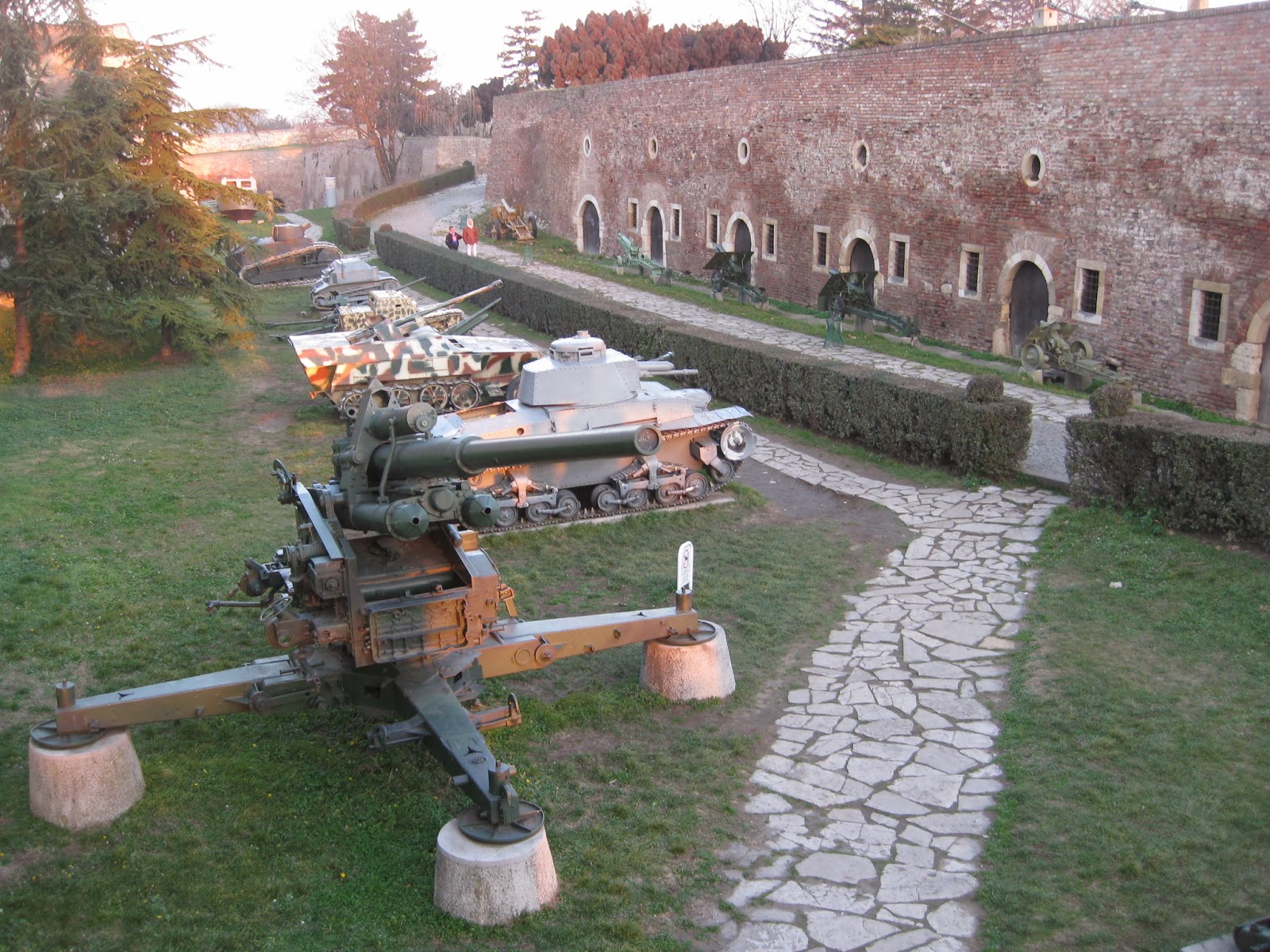
Inside the castle weapons from Second World War
are displayed, Kalemegdan, Belgrade.


Belgrade is absolutely grandiose with wide streets and beautiful buildings that bare witness to its past glory as part of Austria-Hungary and as capital of ex-Yugoslavia. Its location between two rivers and life alongside those rivers on floating restaurants, hotels, bars and cafes makes the city very charming. For sure, there is a certain sadness in the poverty ridden faces of its elderly. As they buy walnuts and peppers in the open market, their broken expressions make amazing portraits while reminding one what bad politics can do to a country. Indeed, the Balkans have not only seen physical damage of war, but also exodus of its peoples with whole communities uprooted from places they lived for centuries. Seen as the culprit of wars, Serbia has been cast aside by the international community for a long time. As it seems to be finally emerging from political isolation, Belgrade's city dwellers, who have been bombed for four times in hundred years seem upbeat, helpful and friendly unlike other Central-Balkan neighbors in Prague, Zagreb and Budapest. It looks like an accident of history that Serbia ended up in such obscurity despite being the largest and most populous country of ex-Yugoslavia and despite its very central location in Souheastern Europe with about ten neighbors.


Inner Istanbul Gate, Belgrade.


Views from Kneza Mihaila.


Belgrade is worth a lenghty visit of at least three days, where possible four and even five. Kalemegdan (Square of the Castle in Turkish) and the park surrounding it are the central tourist attractions in the Old City (Stari Grad). What is really nice about Kalemegdan is that lots of local people enjoy it too. It's a perfect place to watch them while the sun sets over the two rivers and the new Belgrade and locals enjoy a tour or two of chess, a true Slavic obsession. To our suprise, the park also contained the tomb of the Ottoman general and grand vizier Ali Pasha who died in battle in Serbia in 18th century. The park has also towers, walls and other monuments.


Nikola Tesla Museum, Belgrade.


If you go down the park, you can enjoy a lazy afternoon in one of Hala Beton's nice cafes (we picked Toro) right by the banks of the Sava river with the rich and the cool of Belgrade. Or you can exit the park towards the city. It will lead you direct to Kneza Mihaila, which is the main pedestrian shopping center of the city. Grand buildings, street art performers and cafes abound here. The street  then ties into the Kralia Milana and when you turn left, you end up in the Republican Square and further up in beautifully cobbled Skadarska Street (Bohemian Quarter) with plenty of restaurants. If you want to wander around art galleries or enjoy concerts, Kneza Mihaila and the Kolarac building and the Akademski Square are also good options. Off Kneza Mihaila street on Kralja Milana one can also see the impressive Yugoslav Drama Theater building which at the time of our visit was showing Harold Pinter plays. Arts will get bigger in Belgrade, for sure.

"The past goes on forever" barely visible,
Stari Savski bridge, Belgrade.


If you sit by the river and enjoy a drink of cafe in Hala Beton, you will be struck by the number of people who run, cycle and fish along the Sava river. No wonder we spent all our lives watching Serbian basketball, tennis, waterpolo, volleyball and handball players! For a list of Serbian sportspeople, click here. Not to deny their hard work, I believe they owe this success also to the athletic Slavic posture. With men close to 1.90 and women 1.80 meters, when it comes to height, one can easily suffer from inferiority complex in Serbia. 


Skadarska street, Bohemian quarter, Belgrade.


St. Sava Cathedral, Belgrade.


Walking over the Brankov bridge towards Zemun would allow you to take beautiful pictures of the city overlooking the Stari Grad. Once you cross the river, the banks of Danube are dotted with boats and yachts and even hostels. One can only imagine them in the summer when they are full of people, partying. We ate at Gabbiano at the yacht club and went for desert and Slivo to Hotel Moskva. Always full and having hosted famous people of the past, it is the place for people watching.

Hotel Moskva, Belgrade.


On the banks of Danube, Belgrade.

Staring at Zemun, Belgrade.


At night, passing by the super stylish new Gazela bridge, venture out to Ada Ciganlija  (Ciganlija island). This is where you will find live Gypsy music with locals singing and dancing. Be aware that the Crna Pantera (Black Panthers) is an impossible place to find in the island with almost no sign and a shady and dark entrance. Once you are there, the place makes you feel like you entered a time capsule with musicians all dressed in black playing some familiar tunes you thought were Turkish. The stage is complete when a guy who sells red roses enters the scene. As Belgrade is famous for its nightlife, we went to Teatro and then  to the Stefan Brown that is located on the ninth floor of an apartment building with people dancing on the top of the bars. Other recommendations from a local friend included Brankow Club and Disco Bar Mladost but check with the local scene as these places seem to come and go. 

View from Savski most bridge, Belgrade.

View to Gazela bridge
from Ada Ciganlija, Belgrade.

Ministry of Interior, bombed during the NATO campaign.

Ministry of Foreign Affairs, Belgrade.


We stayed at Hotel Excelsior at Kneza Milosa, right by the Serbian parliament where crowds chanted for Milosevic to go. It was close enough to Stari Grad but also very central in other ways, allowing one to see and observe many things in the city. One of these was the St. Sava Cathedral which looks like a mosque to my Muslim eyes. Nikola Tesla Museum dedicated after the work of the inventor of many modern technologies we use in daily life, was also close. Tesla's life is almost a foreplay to what was expecting his country a century later. Born in today's Croatia, he seems to have lived the life of a Austro-Hungarian until he immigrated to the United States. Despite the income that flew from the patents of his inventions, his extravagant lifestyle as a scientist seems to have led to poverty. Years after his death in a hotel in New York, the government arranged for his return to the then capital of ex Yugoslavia. His ashes are now on display in this museum in Belgrade because he happened to be a Serb, although he sat his foot there for only one day in his life. 

Serbian Parliament by night, Belgrade.

On the way to the airport, the taxi driver asked me whether I have seen other parts of ex Yugoslavia. Carefully avoiding the subject of Kosovo, I talked about my visits to Skopje, Prishtina, Montenegro, Bosnia and Croatia. I even said Belgrade was even prettier than Zagreb. I talked about the beauty of Croatia's Dalmatian coast and Osijek. I thought by not mentioning Vukovar I was playing safe, forgetting that part of Croatia was shelled by Serbs during the war. Sure enough, the driver said he was there twenty years ago. As this seems to be during or immediately after the war, a silence fell between us. I didn't ask him what he was doing there and he didn't volunteer any further explanation. Indeed, when one meets people who are 40 and older, one cannot help but wonder what these people were doing during the Balkan wars. A legitimate thought when I saw with my own eyes a 2014 calendar with Radovan Karadzic's picture on it. As reconciliation remains a distant dream in the Balkans, will Belgrade with its night life, resonable prices, sadness but livelyness turn the corner despite corruption and sleaze in the country? Only time will tell. Until then, Belgrade will be the new Beirut.