Showing posts with label island. Show all posts

Aug 30, 2015

Holidaying with the refugees in the Dodecanese

In the summer of 2015, Greece made it to headlines either for financial ruin or for refugees crisis. In the Dodecanese islands off the Turkish coast, you see less of the first and plenty of the second. After all, the Syrian war is not ending despite four years of devastating warfare and it is now the middle classes' turn to leave the country. As entering Europe is allowed only illegally, they therefore land in the closest Dodecanese Islands like Lesvos, Chios, Kos, Leros off the Turkish coast. Usually they loom at the harbour either waiting for ferries to take them to mainland Greece and beyond or at police stations on the side of the road while lining up for registration.

Hora on the top of Patmos island, Greece.

Travelmind is a family enterprise: my sister is posing in Hora.

Hora has many nice shops overlooking Patmos island.
One of the furthest islands off the Turkish coast, Patmos did not change much since I saw it ten years ago. Given the distance, it is not receiving refugees but many pilgrims that arrive by huge cruise lines on a daily basis. Indeed, Patmos' Hora is called the Jerusalem of the Aegean. It has been declared a UNESCO site as well as a "holy island" by the Greek Parliament for its religious significance. If you want a little peace and quiet in Hora, you should pick a day where a cruise won't be coming. After a tour at the top with excellent views, have dinner at Jimmy's with the best view of Skala and beyond. If it is a cruise day, just skip dinner in Hora and head down to Skala. Dinner either at Pandelis or Tsipouradikos by the sea are excellent options.


View from Jimmy's in Hora, Patmos.
A view of Skala from Jimmy's Balcony in Hora at Patmos island.


The best sunset in Patmos is on the road to Kampos.
At Tsipouradikos, the tables are set by the sea.
Patmos is a small island and transportation is easy with taxis but renting a car is also an option. We stayed to the north of Skala in Kampos. Although the Kampos beach can be crowded, it does not have that many buildings as other popular hotel areas like Grikos or Skala. Its village square up the road is very nice. Across the church, Aroma is a nice place to enjoy island food like goat and lamb, deliciously cooked. Other beautiful beaches include Agrio Livadi; Livadi Kalgiron (a must if you like the atmosphere of a fishermen's refuge); Lampi (another must) and Livadi Gerano.

At Kampos beach, enjoy Taverna Agnadi.

A farmer in Kampos, Patmos island.

Kampos beach, Patmos island.

Lampi beach on Patmos island.
While Patmos is relatively far from Turkey, Leros is much closer. It is also much bigger than Patmos and there is a lot to see. As we got off the ferry in Lakki, the refugees were hiding from the sun in the shadow of empty buildings and a park. It is indeed a sorry feeling to pass them by and head to your hotel. We stayed in Aya Marina at La Maison des Couleurs, a beautiful mansion with few rooms. When staying there, swimming in Panteli beach is an option but it can get crowded in its narrow strip. If you walk down to Aya Marina, dinner options at Taverna Bratsera or Mylos are highly recommended. In fact, the whole Aya Marina Bay is quite nice with cafes. Walking by the refugees filling the patio of the police station there in full evening do is an embaressment, at the same time, it is an opportunity to see their situation and face the consequences and delusions of European political decision making. An example is a restaurant owner's accussatory tone who said that they were coming to Leros from "us" ignoring the fact that "we" already had two millions of them in Turkey.

Vromolithos beach in Leros island.

Breakfast table at La Maison des Couleurs at Leros.
View from Mylos Restaurant towards Aya Marina, Leros island.

The famous wind mill at Mylos, Leros island.

In our short stay, we loved the Vromolithos beach. It was like Bodrum in the 1980s which gave us a sad feeling. In fact, walking by the beautiful summer houses in Leros, most of which are either for sale or empty and crumbling, one also sees opportunity in the economic crisis: it is possible to run away from the calamities across the border to here, not only for the refugees but also for us. Unlike them, I would rather stay, rent a place in a totally serene world, with pristine waters and an unspoilt coast. In fact, we are so lucky to have Greece to have in our immediate reach. All you have to do is to go to Bodrum and take the ferry.

The Lime Bar at Merikia, perfect spot to end the day.

The French playing petanque in Merikia Leros
right in front of the War Museum.

Italian architecture in Lakki, Leros island.
As with many of the Dodecanese Islands, Leros has an interesting history. Italy's occupation of the Islands left its mark not only in terms of Italian identity cards (see picture) but there is Italian architecture to be seen around especially in Lakki. In Merikia, close to Lakki, there is an interesting  museum from the Second World War that we could only see from the outside due to being open only half a day. Ironically for the European venture though, the French were playing petanque in its very vicinity.

Aug 31, 2014

Limoncello for mastique in Ioanian islands

Kerri caves in Zakynthos.

Bridge to Agios Sostis in Zakynthos, Greece.

Our arrival in Athens was so refreshing. As we walked by TVs at the airport, not seeing Erdogan on every channel was already feeling like liberation. Then we started to look for a place to buy tickets to the bus station, an old man approached us in Turkish. For someone who migrated to Greece 50 years ago from Istanbul, he spoke amazingly well. His reply: "We are the children of the Ottomans, we are Istanbulian". His strong identification with his homeland struck me since he ended up selling lottery tickets at his 70s with barely any teeth in his mouth. Indeed, no matter how Western-forward looking, the Republic of Turkey was a nation state that barely left any breathing space for minorities like him while quiet contrary the Ottomans were in the end a multicultural empire. It seems that no matter what I did, I could not avoid politics in the land of polis and politics. Next, our taxi driver turns out to have lived in New York City, he tells us with his perfect English that he has no political hope for his country. In fact, these men were the epitomes of the crisis ridden, staid Athens. Even on a Saturday, stores were empty and full with for sale/rent signs. Let alone new buildings not being seen, people do not even have new cars. It is like the city is frozen in the 1990s.  

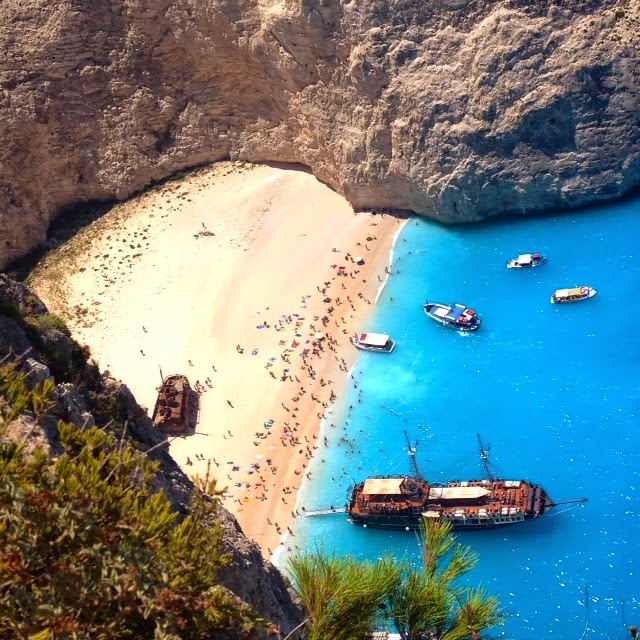
Navago Bay from the top, Zakynthos.

There are various versions as to how the shipwreck
landed here at Navago Bay, Zakynthos.

After this depressing sight, the vibrancy of the Ioanian -the Italian- islands of Greece make a good start for vacation. You should forget about the white and blue typical Greek thing here. Even the names of the islands are Italian like Zante for Zakynthos and Corfu for Kerkyra not to mention Italian delicacies being cooked also well. To get to Zakynthos, taking the bus instead of the flight is not only cheaper but also provides a great opportunity to pass through the Corinth Canal and see the southern shores of the Ioanian Sea dotted with summer houses and cypress and olive trees. After a six hours drive, we arrived at Killini to cross to Zakynthos. It is a huge island so renting a car is a good idea and beware of package tourist filled beaches such as Laganas. This is also where the party crowd is and the main street is filled with Bodrum style clubs and bars. At the same time, the boat trips to see the sea turtles and the Kerri caves also depart from here. If you want some peace and quiet, stay in the southeastern part of the island in Vassilikos like we did. 


A caretta caretta at Laganas, Zakynthos.
Picture: Sinan Güngör.
Corfu looks a little bit like its close neighbor Dubrovnik.
Picture: Sinan Güngör.


Zakynthos is home to one of the most known beaches in Greece: Navagio beach (the Shipwreck Bay). It is in the Northwest part of the island and if you get lost like we did, it might take up to two hours to get to. Nevertheless, the mountain villages of the island make it worth the trip. On the top of the hill where one can take pictures of the bay, there is an incredible line under the burning sun. Unless you are a pro photographer, skip the line and take a shot from the sides. Although the view and the color of the sea look pretty amazing, the spot is packed with tourists. In order to access the beach itself, you will need to go down to Vromi and take a boat. Once you are at the beach, forget about a peaceful stay since there is constant boat approaches and people arriving and leaving. Also, swimming is not that nice since the limestone that gives the sea its incredible blue renders it low visibility. Note that there is not even a single spot to buy any water or drinks. 


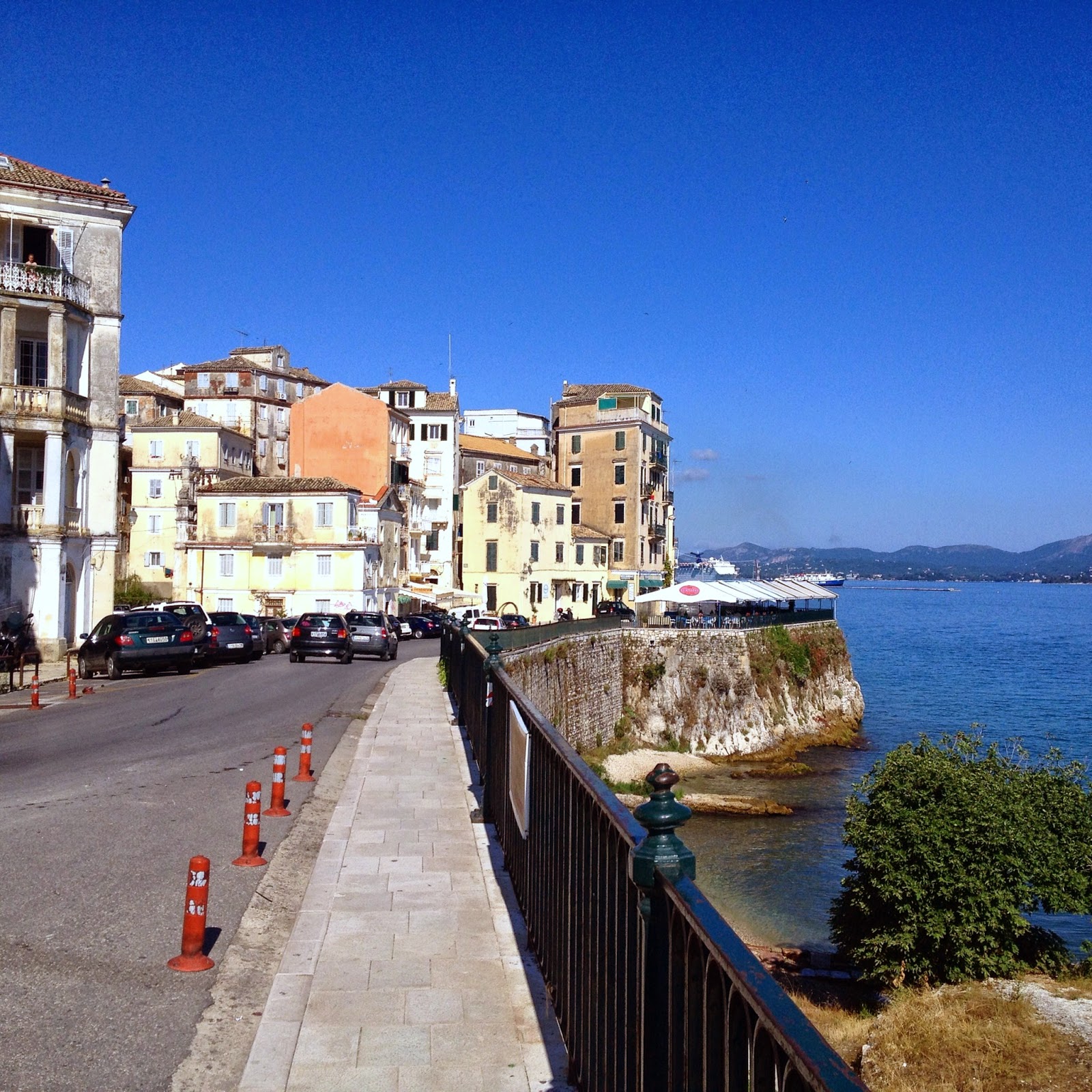
The Esplanade in Corfu town is full of people after sunset.


The food on Zakynthos island is great with usual Greek goodies but try the island rabbit that is cooked with local herbs. If you are in the southeastern side of the island, on the main road Taverna Agnati is superb. And do not be suprised at the Italian touches after dinner such as being served limoncello as appetizer. And for the after hour partying, overlooking Zante town, go to "the Island". 


Catholic outside, notice the tower of the church,
Orthodox inside, Corfu, Greece. 
Kanoni can be spotted from the air
if you are arriving to Corfu by plane.


Of the "Italian islands", the most mixed is probably Corfu, given also the fact that it remained the only Greek soil that did not fall under Turkish occupation. In fact, the Italian -Venetian- influence is very strong starting on the mainland close to Patras, not to mention the islands, even the churches look Catholic from the outside although they are clearly Orthodox inside. Despite the clear Italian influence, Corfu was the place for artists and writers not only of Greek origin as the signs on many houses attest. Its charms are today enjoyed by many more today given its proximity to the Balkans. Indeed, there are many Serbs, Albanians (right across the island), Roumanians and Slovenes that add to the mix and in a way revive who ever has left its prints on the island from the Brits to Russians and French and the Venetians. Its great climate definitly must have contributed to this: it is not burning hot like the Aegean islands and is very green.


Views from Corfu town.


Corfu is huge and is preferebly enjoyed with a car but in the town itself parking and one way streets can be a problem especially in the high season. You should spend some time in Corfu town and enjoy the architecture, the fort and dining in the old establishments such as Rex (fancy great) and Chrisomalis (not fancy, old school great) and newcomers like la Famiglia. Again, these places serve traditional goodies (fish soup) as well as fine Italian ones. For breakfasts -difficult to find- try the le Petit Fleur. Once you are in town, visit also Kanoni, only 1 km from the town. After that, you should try beaches of the island according to your preferences. We mostly stayed in northern and western parts of the island.

Corfu Promenade has romantic views in the evenings.


Glifada and Paleokastritsa are both very nice beaches. However, my favorites were in the northeast of Kerkyra: Kouloura and Kalami where the Durrell House (owned by Durrell brothers Lawrence and Gerard) stood. These are also spots where you can see Albania. In fact, daily tours to Saranda and surroundings are availabale everyday from Corfu town. But then one wonders, it is so peaceful and tasteful here, why bother?

A house in Kouloura, Corfu island, Greece.

Corfu fort, Greece.

Durrell House in Kalami, Corfu.

Special thanks to Sinan Güngör for his important contribution: remembering restaurant names.

Nov 14, 2012

Tormented by politics in the Dodecanese


For all the gloomy politics and doomsayers of Greece, the Aegean Islands just off the Turkish coast (the Dodecanese -twelve- islands) are still a great escape. It's not only beating the crowds of mainland Turkey that drew Turks there on a long religious holiday. But it is the comfort of feeling at home since the food and the people are very similar. Yet, it is still different given the religion, language and architecture, not to mention the inertia that Greeks seem to have adopted towards government and public life in general. In fact, this inertia drove us at times mad as we seem to have increasingly low tolerance for non-customer oriented service mentality. 

View from hotel room at Pedi Bay, Symi, Greece
while Coldplay's Paradise plays in the back.

Kali Strata cafe/bar at Symi Island.

Kali Strata bar's famous cushions at Symi.


One of the most picturesque Dodecanese islands, Symi can be best described as a mixture of Portofino and Dubrovnik. Like all Dodecanese islands, it has an interesting historical heritage: it belonged to Ottomans, Italians and then to Greeks. It is protected by geography: due to the ferry schedule, it takes an entire day even from the hub of the Dodecanese -Kos island- to get there unless you are on a private boat.  The ferry lands right at the clock tower, where we are picked up by our host who drives us to Hotel Taxiarchis located in the quieter Pedi bay. He sais if he knew we were coming from Datça, literally right across Symi on the Turkish side, he could have picked us up by boat:-). Pedi is 15 minutes away from the downtown area of Symi and involves a steep walk but is worth for its views. As we walk down, we spot Kali Strata, a cafe/bar where on the cushion covered steps you can enjoy coffee or better drinks with the sunset while overlooking the yachts at the harbour.

Streets of Symi Island, Greece.


There are many options for dinner in Symi's downtown. We deliberately avoided the huge, crowded and overpriced Manos that greets visitors at its prime location. Instead we ate in the back streets, at Meraklis and Naeira, both of which serve extremely delicious food. Another option at night is to walk to the other bay Kolonaki. Hotel Aliki, an extremely charming boutique hotel, operates a resturant called Vaporetta. We could not eat there but saw two Turkish tycoons doing so with their entourage so we assume it must be good given also the charming looks of the boutique hotel. Very close to Vaporetta is a sea side bar called Tsati, not only romantic but also where waves can wet your feet while you sip your coffee. What ever you eat at Symi, do not miss the Symi shrimps which are small and eaten with their skin and the mastique ice cream.

Symi island, harbour, Greece.
Picture: Sinan Güngör.


Swimming options are good at Symi. One day we walked down to Pedi beach and took a boat to Aya Nikola for €5. Another option was to take a boat tour for €35. You can enjoy excellent beaches such as Aya Yorgi or the Monastery. Indeed, this small island has so many monasteries everywhere. During the boat tour we ran into a Greek man who was originally from Istanbul. He was dying to speak Turkish with us and after small talk, the unavoidable subject of politics surfaced. Our friend had to run away from Turkey in 1978. He told us it was still hurting him to have left home. He told us how he did his military service in Central Anatolia and how he was beaten countless times during it, for being Greek/Christian. He mentioned the notorious "citizen, speak Turkish campaign" and the beatings he witnessed during that time for speaking Greek in public. Because of that, he still felt nervous when speaking Greek in Istanbul. He said he realized that all of this changed now and wanted to know what we had to say to all this. What could we say? Turkey's sins are so overwhelming and widespread, it catches you in unexpected moments like this and torments your soul.

Aya Yorgi beach, Symi Island.


Aya Nikola beach, Symi island.
Picture: Sinan Güngör.

Symi at sunset,
Picture: Sinan Güngör.


Sensing our sadness, our friend started criticizing the boat owner for serving ouzo without water melon, a must in Turkey. "These Greeks cannot learn this!", he said in desparation. He also complained about his second wife, from mainland Greece as opposed to his first Greek wife from Istanbul. Except the language and the religion, there were no similarities between them. Besides, mainland Greeks were not religious enough. Whether Turks could contribute to the Greek economy by visiting more? We said that only when the visa was lifted. He added: "we do not want the headscarfed ones though". It was so interesting to note how his identity shifted back and forth during the conversation, finally ending with the Kemalist Turkish one:-).

Views from Aegean Tavern, Kalymnos island, Greece.


Telendos rising as viewed from Kalymnos.


Next day, we headed to Kalymnos which is not as picturesque as Symi but is a sponge island and is one of the best rock climbing spots of Europe. We stayed in the back of the island at Myrties Beach with a wonderful view to Telendos island that was rising like a volcano. Without the breakfast our newly renovated room cost €40. Turks never sat foot on this island but only taxed it while Germans seem to have occupied it during the Second World War. It joined Greece as late as 1948. Due to the recent economic difficulties, about 7000 people seems to have left the island for the United States and Australia. 


This man on Kalymnos says:
"we were Italian once".


Kalymnos island is full of sponge shops like this.


In the two nights we stayed in Kalymnos, we dined at Aegean Tavern at the Massouri beach. The mezes, main courses, price, decoration, view and service were excellent. Amid this atmosphere, just like in Symi, we were all of a sudden again faced with politics when our waiter started speaking Turkish with us. He was from Lebanon but his family's origins were in Adana (southern Turkey). In other words, he was Armenian. I figured that his family must have escaped either during the pogrom in 1909 or the genocide in 1915 but he was graceful enough not to mention all this and to just put it as: "my family is from Adana". In fact, he may not have spoken Turkish with us and revealed his identity. But just like the Greek guy from Istanbul, he was dying to speak with us. Is this a version of the Stockholm syndrome I wondered. I am unsure whether I would continue speaking the language of the country that my forefathers have been kicked out with no apology or compensation after almost 100 years. After these two incidents that just bursted in the middle of my Dodecanese phantasies, I wonder whether there may be any peace or an escape from politics for a Turk. Maybe not. Maybe there shouldn't be until we can do more than bowing our head in shame.