Showing posts with label Turkish bath. Show all posts

Dec 23, 2011

Before Constantinople, there was Adrianapolis


The closer it is, the further it becomes. 220 km northwest of Istanbul, barely 2,5 hours drive on a flat highway, I haven’t made it to Edirne until recently. Known as Adrianapolis, this military outpost served as capital of the Ottoman Empire for almost hundred years (1367-1453) before Istanbul. And it showed! We stayed in Taşodalar, the estate where Sultan Mehmet II (the Conqueror of Istanbul) was born.  It carried this name for the last 600 years. Now renovated, it was located right behind the master piece of Architect Sinan’s Selimiye Mosque. And even better, adjacent to it, there was a Turkish bath (Saray Hamamı) where we spoiled ourselves beyond our senses.


The Old Mosque in Edirne is full of calligraphy.
Photo: Zeren Göktan.

"Allah" enscribed with calligraphy over believers at Edirne Old Mosque.
Photo: Zeren Göktan.

Arabic letter "vav" on the wall of the Old Mosque in Edirne.


A view from the serene Old Mosque in Edirne.
Notice the different architecture without
one big dome.


While the Selimiye Mosque is Edirne’s most famous monumental building, the town's early Ottoman period mosques are also considered unique pieces of architecture. They date from a period before the synthesis of Islam and Turkish civilizations came to a completion and while the signs of Seljuk style were still visible. One example is the Eski Camii (Old Mosque) of 1414 described by architect T. Cansever as standing as a sign of permanency.  It is also the first monumental building surviving from the early Ottoman era with its oldest pulpit (minber). Amid the Muhammad and Allah scripts right at the entry gate of the mosque, the Arabic writings on the walls of the mosque dating from the 18th century were truly mesmerizing. Their calligraphic beauty combined with the effect of the live prayer, turned it into a divine session for me. I was so impressed  with the muezzin’s voice, I couldn’t help to listen to him until the end. Our later discussion led him to show me around the mosque: pomegranate tree symbolizing heaven in Islam, the calligraphic art variety Sulus and my favorite prayer on the wall (la havle). He even introduced me to the governor of Edirne (who was among the praying crowd) to have me repeat the praise I had for his voice. When I confessed him that I was not “so religious”, I was taken by his response: “nowadays, religion is too much associated with appearance”, clearly taking note of me not wearing a headscarf but implying that covering one's head was not the only way to determine one's religiosity.


Inside the Three Balconied Mosque in Edirne.


Three balconies of the minarette in Edirne. 


After questioning what it means to be a faithful person a little more, we then hit the Three Balconied Mosque (Üç Şerefeli Camii). Also dating from the 15th century (1447), this mosque had four minarets that were all in different length, width and shape, one of which had three balconies, hence the name. This mosque is considered as the beginning of the later emerging Ottoman architecture. Lastly, we went to Selimiye (in İçkale district) which serves as a point of orientation since it is visible when you reach the town from Istanbul or other directions.

Selimiye mosque's famous marble mihrab in Edirne.
Photo: Zeren Göktan.

Selimiye Mosque in Edirne.
Photo: Zeren Göktan.

The dome of Selimiye Mosque in Edirne.

The minber (pulpit) of Selimiye Mosque.


Selimiye is considered Architect Sinan’s masterpiece although it was built after his other great work of Süleymaniye Mosque in Istanbul, in the name of Sultan Süleyman the Magnificent. Just like the other sultans before him who had all erected mosques in their names, Istanbul was the natural location for Sultan Selim, the son of Süleyman who was patronizing the mosque. However, it was soon realized that there was no place in Istanbul (Old City). Hence, Edirne as the gate to Europe and former capital has become the natural choice to demonstrate Ottoman power to Europe. Selimiye’s dome is indeed impressive not only with its height and width but also the Islamic art on it and its pastel tones.There is also a myth that accompanies the mosque. Apparently Edirne was full of tulips (and tulip gardens) at the time. When Sinan found the spot to build the mosque, its owner, an old woman was not willing to give her land. She would only be convinced if Sinan built something in the mosque that would remind future generations of her. So, in a truly subtle artistic way, Sinan made a tulip on a barely visible part inside the mosque. However, the tulip was put in a reverse fashion to symbolize the trouble she caused himJ.


Views from the streets of Edirne's Old City.

The synagogue of Edirne, due for renovation. 


I don’t think I ever made it to so many mosques in a row at any time in my life and –surprisingly- enjoyed it that much. Maybe religion was indeed not about appearance and about your heart. Maybe it was the diversity of styles, stories and layers in Edirne that gave one this feeling? Edirne is indeed a colorful place, full of students and people. They flock to Edirne’s liver and köfte shops. The town borders both Bulgaria and Greece as evident from the signs in both countries’ languages all over the city. After all, it is located in the Balkans, always first to catch snow coming from there to Turkey. Another natural element to Balkans are the Roma people who live in various Balkan and Central European countries. Their presence adds another color as they ride around the city in horse cars and sing while listening to their hand held stereos. They are also in the business of picture taking amid plastic flowered walls behind Selimiye mosque. Right behind the mosque, Köfteci Osman is excellent place to taste köfte (meat balls) also because the shop uses really good olive oil in its salads. This is truly unusual in Turkey but given the historical oil wrestling in the town, it should probably not be a surprise. 


The pedestrian market zone in Edirne.

Thrace University building in Karaağaç, Edirne.


The town is located by the river Meriç (Maritsa) which was navigable until the end of 17th century. Today, at the river side one can spot couples, men sipping raki (Turkish ouzo) on grass and restaurants (Hanedan was our favorite). When one crosses the old bridge to reach Karağaç and the campus of Thrace University –itself a magnificent building- one is only kilometers away from Greece. Given the commercial activity associated with the river  as well as its location, Edirne was once home to sizeable minority populations such as Bulgarians and Jews. Unfortunately, the pogrom of 1934 in Thrace all but ended the latter’s presence. Today, the beautiful art nouveau synagogue building is finally being renovated while the Sveti Yorgi church holds mass every Sunday with a crowd of mere 30 people and those coming from Bulgaria. Minorities always pay for the establishment of nation states:-).

Old bridge over Maritsa (Meriç) river.

An illustration of the music therapists of the
Beyazid complex in Edirne.

The Health Museum in Edirne won the
2004 Council of Europe museum prize.

A simple room in the hospital section of the complex in Edirne.


Another place not to miss in Edirne is the Health Museum that won the 2004 Council of Europe Museum prize. Located in the hospital section (Darüşşifa) of the Complex of Sultan Beyazid II (1484-88) beside the Tunca River, this was a place where mentally ill patients were treated with water and music therapy. In fact, a different rhythm was used for each different illness. For more click here. Having served for 400 years as hospital, it later became a hospital for the mentally ill. The complex included a medical school, a guest house and a soup kitchen, as well as a mosque. When the Empire was falling apart after the Balkan War, Edirne was occupied by the Russian Army. As a result, the hospital also fell apart. Patients started to be held in isolation and in chains while the welfare system of the complex all but collapsed. While the building was later used for other governmental purposes, thanks to the renovation it again found a purpose in the form of Health Museum. One of the scenes at the Museum I really liked was the fact that two patients, described as melancholic depressive and lunatic, were housed in the same room. The Turkish translation of melancholic basically refers to someone who is so hopelessly in love, he has lost his mind. Under the circumstances, his roommate cannot be anyone but who has lost it totally, don’t you think?

The melancholic depressive and his roommate the lunatic
at the Health Museum in Edirne.

Prayer beeds inside the Bayazid mosque in Edirne.


The Bayazid complex in Edirne from outside.

Postcard showing Bulgarian machine guns
before Adrianapolis during the Balkan War.
(Courtesy of TT). 

Feb 5, 2011

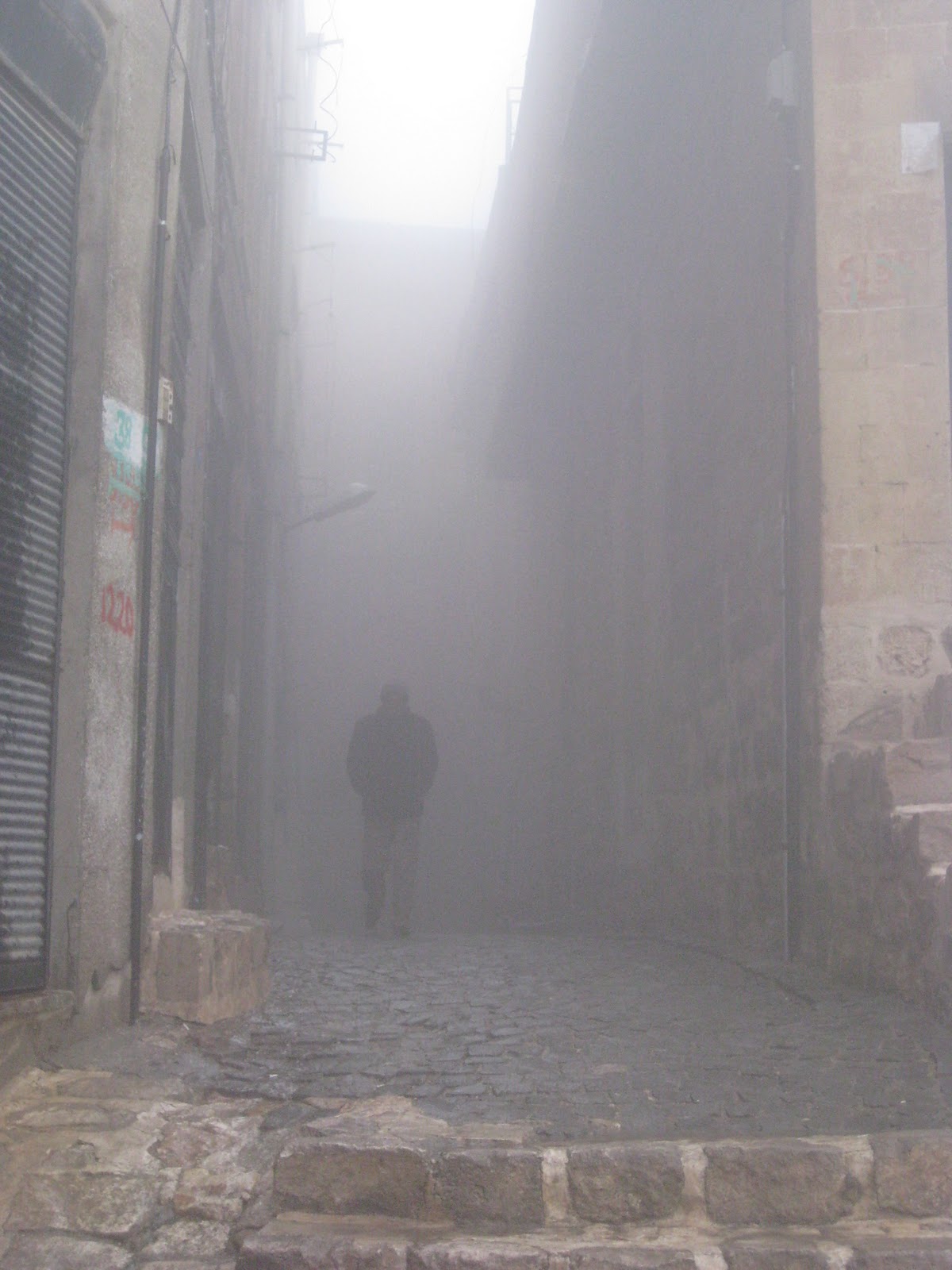
Cursed or blessed by the fog in Mardin?

In the 1990s, Mardin used to make to headlines with fighting in its surrounding regions between the army and PKK, often with dead soldiers and evacuated villages. Since then, however, it has seen a big revival. Nowadays it makes to news with its biannual, fashion shows of Rifat Özbek and renovation work in order to be declared a UNESCO world heritage site. There is even an exhibition of Abidin Dino the famous Turkish painter, all of which were unthinkable even ten years ago. Thus, tourism to Mardin and surrounding places like Midyat and Dara have exploded.

The fog in the old town in Mardin.


Mardin is located in South Eastern Turkey in Mesopotamia, the land between two rivers (Euphrates and Tigris) and at the cross road of cultures. The old town is dominated by the castle on top and the centuries old houses that are fine examples of masonry in the region. The houses have an amazing view towards the Syrian plane right on the footsteps of the city. In the summer, their rooftops are dominated with bed frames. People put mattresses on them and sleep under stars. While the stone masonry is owed to Assyrians and Armenian masters, in terms of architectural gems in the town the Artuquid period must be also mentioned fine examples of which dominate the town. Unlike many parts of Anatolia, Mardin was introduced to the Turkish-Ottoman culture in the 16th century. But Mardin’s greatest lure is its multi culturalism as evident from places of worship in all sorts of faith.

Entrance of the Sabancı City Museum in Mardin.

Abidin Dino's ID card in the Sabancı Museum in Mardin, notice his birth
date on the bottom right according to Islamic calendar, 1911 in Roman.

In my only day in the old town, I woke up with joy ready to explore it all, only to discover that mother nature had other plans in store: visibility was zero. Hoping that it would go away by mid day, I grumblingly went  to the Sabancı Mardin City Museum.  I usually am not a big fan of museums since I tend to get overwhelmed by the amount of things to see. I now thank the fog since without it I was not going to learn so much about life in Mardin. A part of the museum celebrates Mardinians: Arabs, Kurds, Assyrians,  their lives and their faith. It is a testament of the rich cultural heritage of the town as well as their loss due to modernity, poverty, guerilla war and intolerance. To begin with the first, I learned that the town used to have many coppersmiths located in the bazaar. But with the advent of steel and chrome, copper’s popularity diminished. So coppersmiths have all closed down. Today, the few remaining masters teach it so the art would not perish completely. Indeed when you walk around the town, you see many small artisan shops in which people are trying to make a living.  This is a common scene in many towns in Anatolia and makes you sad. Clearly these small artisans do not really know another craft that than their art. 

A tailor store in Mardin.

Above some doors there are ceramic plates and Arabic scripts in Mardin.

When I first saw him, he was gallopping but after getting the sack,
he carried it on his shoulder and not on the horse.

Another common thing is how ready people are to talk to new faces and ask them where they are from. When you say you are from Istanbul, they immediately ask whether you know their relatives in Istanbul. It is hard to explain that there are thirteen million people in Istanbul. You hardly know your neighbors.

Emir Turkish bath in Mardin in dense fog.

Entrance of the Abdullatif Mosque in Mardin.

The hardly visible minarette of the Abdullatif mosque in Mardin.

The Abdüllatif mosque in Mardin is built in Artquid style.
The museum also taught me that of Mardin’s Assyrians, 80% were jewelers. There are many jewelry stores side by side on the main street but unfortunately, many they have left the town in search of a better life as well as for security reasons to freely practice their religions . Some Assyrians remained, like Nasra Şemmeshindi, an old Assyrian lady engaged in cloth printing. She continues drawing scenes from the Bible on clothes. Indeed, many crafts in Mardin date back generations in families. However, when family members are scattered around the globe, it becomes harder and harder to continue. Or take masonry. It almost died out until the revival of the town. Today, in order to catch up with the speed of renovations, the only two masters who were left had to train the new comers. But as the people in the video attest, Mardin’s revival came too late for some people. They moved to Beirut then to Sweden or Germany or Canada and the U.S. and built their lives from scratch.

Typical architecture and fine example of masonry in Mardin.

Camlı Köşk Kıraathanesi in Mardin.


Culture and language wise, the museum also put a smile on my face. I learned that because of the small streets of the old town that were navigable only with donkeys, baskets put on the donkeys to carry stuff have become a measure of weight in the city: one donkey load. Or that people in the town speak Arabic while in the surrounding towns Kurdish is spoken. But languages and cultures are so intertwined, you can hear the same song sung in Turkish-Arabic and Syriac. Or sometimes the lyrics of one song is trilingual. The museum also showed old licenses and birth certificates that have been issued in the first years of the script reform in Turkey. This is  clearly visible in the flickering way Latin letters are written, typical of that generation who were born into the Arabic script  but then had to learn Latin letters from scratch.

Notice the pigeon figures in the masonry in Mardin.

The entrance of Artuklu Kervansaray Hotel in Mardin.
Another thing the museum brought to my attention was the prevalence of pigeon figures in Mardin’s architecture.  Given its religious significance in three religions, all of which had adherents in Mardin, this is probably to be expected. While pigeons were the first bird to be domesticated by human kind, in this part of Turkey, pigeon rearing is very popular and Mardin has its famous “somersaulting pigeons” or tumbler pigeons. According to the Anadolu Jet Magazine, all families in the town breed pigeons and what makes these somersaulting pigeons special is their flying style, the sound of their flapping wings and the games they play when doing loops and dives.  In fact, pigeon breeding  is a true obsession for men in Turkey to the extent that there are pigeon festivals where beauty queens and kings of pigeons are selected and breeders come together in search of a male or female for their loved ones:-). There are also pigeon auctions. I know all this because of my close friend and artist Zeren Göktan shot a video about pigeon breeders in Turkey, Iran, Armenia and Azerbaijan. She explored the passion men (no female breeders) have for these birds . You should also take a look at some videos pigeon owners have shot like this one. When I got out of the museum, I looked in the sky to see some myself but the fog wouldn’t allow me to see anything.
Notice the male population in the pigeon festival in Bursa and the
saw dust in the cages to avoid slippage.

Jury on duty at the pigeon festival in Bursa.

After tasting Mardin staples like lahmacun and “sembusek” (a calzone shaped lahmacun), I visited the Abdüllatif Mosque from the 14th century built in Artuqiuid style.  I then visited the close by Turkish bath called Emir and ended up in Camlı köşk kıraathanesi (coffee house for men) to warm myself up. But it was getting chilly, and there was no point in insisting on sightseeing, so I headed to my 800 years old hotel which used to be a caravanserai and has been beautifully restored . Luckily, I discovered a second Turkish bath on the hill right behind my hotel. The Savurkapı bath dates back to 12th century and I got there just on time before closing. The women spoke not much of a Turkish so it was kind of amusing how she ordered me to do things to scrub me: lie down, turn your back, come here. TL 10 for the bath and TL10 for the woman who scrubbed me, the whole thing cost me TL 20.  I then dined at Cercis Murat Konağı which was an amazingly delicious experience typical of the Mardin Assyrian cuisine located in a typical Mardin house. Apparently it has a branch in Istanbul, yummy!

A staple of Mardin cuisine: sembusek.

The Mardin bread with the whole in it is called Keh in Arabic.

Cercis Murat Konağı restaurant in Mardin, great food.
Referencing a Virtual Tourist listing, Radikal reports that the Mardin Post Office is one of the top ten post offices to be visited. Unfortunately I did not have a chance to see it but the next day when I hit the road further east, I thought that maybe a foggy day did not allow me to see much of Mardin but sometimes one should go deep than going wide. Even an experienced traveler must remember basic lessons every once in a while.

A shorter version of this post is available at Hurriyet Daily News.